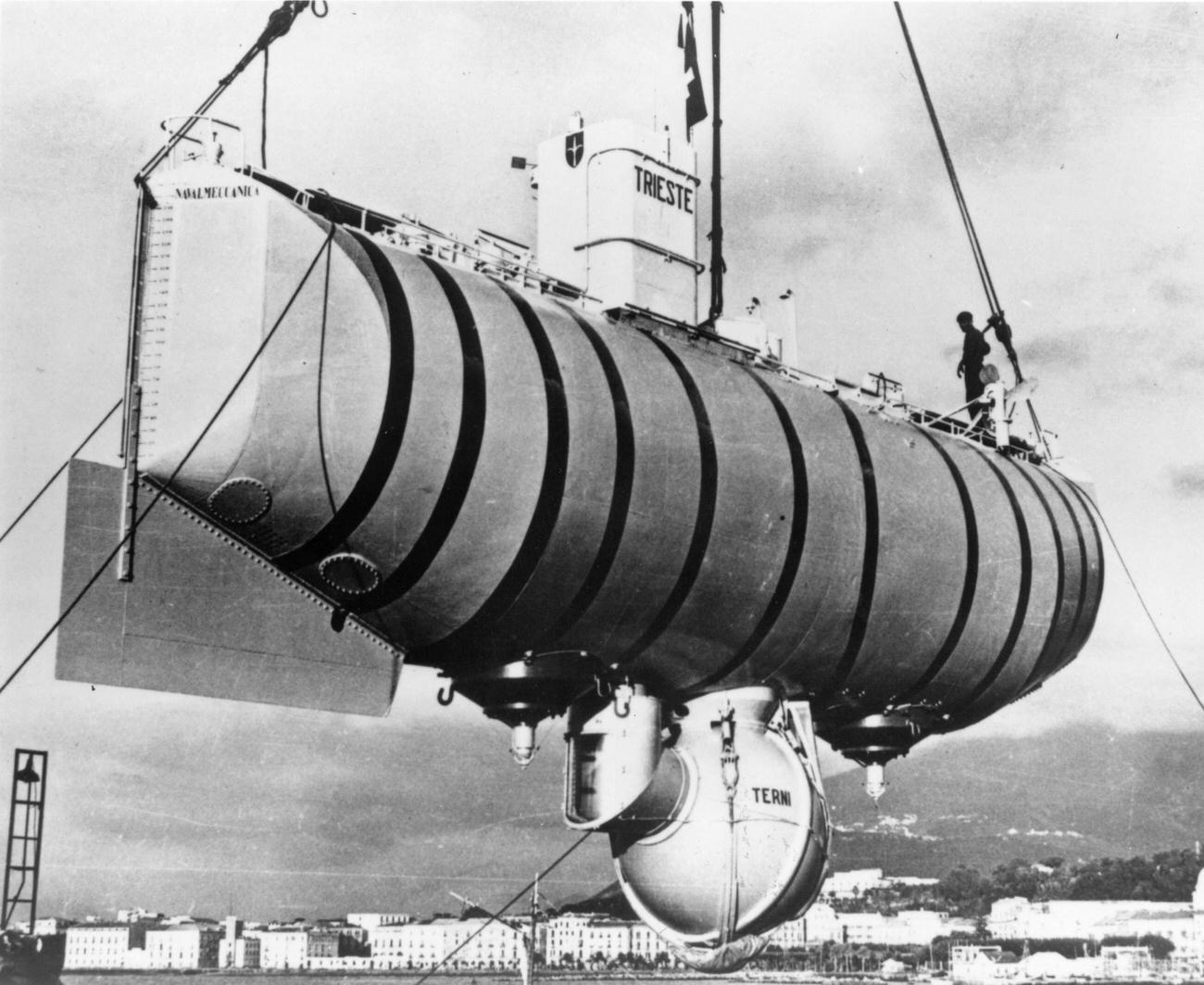
Suspended by cables above a waterfront skyline, the bathyscaphe Trieste looks less like a boat than a carefully balanced experiment in buoyancy. Its massive float dominates the frame, banded and riveted like industrial armor, while the small spherical pressure cabin hangs beneath—an unmistakable reminder that deep-sea exploration depends on both scale and precision. The bold “TRIESTE” lettering on the superstructure turns the machine into a statement of purpose, built to endure a realm where darkness and pressure rule.
Designed by Auguste Piccard and his son Jacques, Trieste belongs to the great mid‑century surge of invention that pushed human curiosity into environments once considered unreachable. The photo emphasizes engineering over romance: a workman stands atop the hull, rigging lines trail away, and the entire craft appears to be in the midst of preparation, testing, or transport. Even without a visible launch, the scene conveys a moment when oceanography, physics, and practical shipyard labor met in a single, ambitious vehicle.
For readers searching the history of deep‑diving submersibles, this image offers a vivid, SEO‑friendly glimpse into how a bathyscaphe was built and handled above water before descending into the abyss. Trieste’s distinctive combination of a large buoyant float and a compact pressure sphere evokes the era’s solutions to extreme depth—simple in concept, daunting in execution. As a piece of technological heritage, it stands as a reminder that breakthroughs in undersea exploration often begin not in the ocean, but on the dockside, under cranes and cables, with invention made visible.