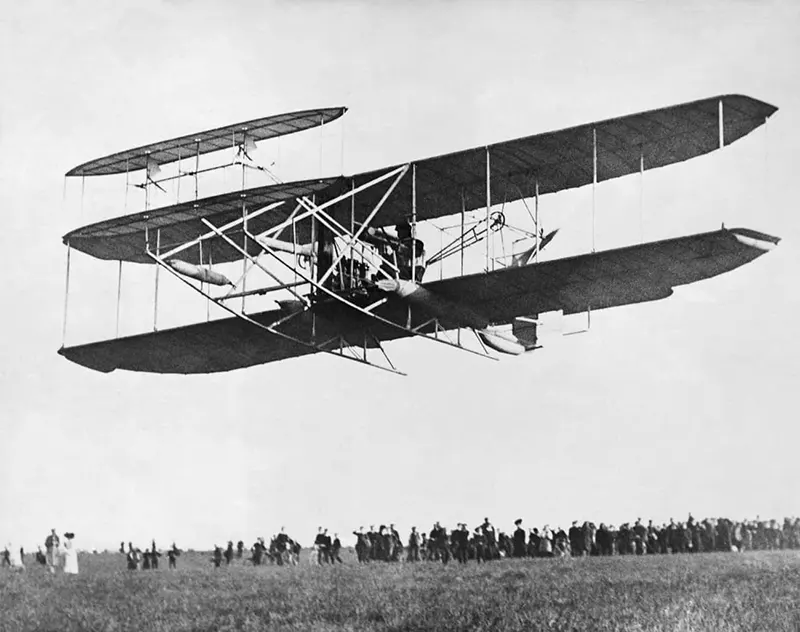
High above a grassy field, a delicate-looking biplane lifts into the open sky, its skeletal frame and fabric-covered wings laid bare for all to see. The craft’s twin planes, web of struts, and exposed control surfaces speak to an era when aviation was still a hands-on experiment, built as much with ingenuity as with tools. Along the horizon, a dense line of spectators gathers, reminding us that early flight was a public marvel—half scientific trial, half community spectacle.
Linked to the Wright brothers and the 1910s, the scene evokes the period when their demonstrations helped transform powered flight from a daring proof-of-concept into a technology with real-world possibilities. The aircraft’s visible bracing and open cockpit underline how immediate and mechanical these machines were, closer to a workshop prototype than the streamlined airplanes that would follow. Even without fine detail on individual faces, the composition conveys the drama of invention: a new machine in motion, a crowd watching history happen in real time.
For readers interested in inventions, early aviation history, and the Wright brothers’ legacy, this photograph offers a vivid window into the practical realities of flight’s pioneering decade. It’s not just about a plane in the air; it’s about the culture of experimentation—public tests, incremental improvements, and the confidence to take to the sky in a craft that still looks startlingly fragile. Images like this help explain why the 1910s became such a pivotal chapter in the story of the airplane.