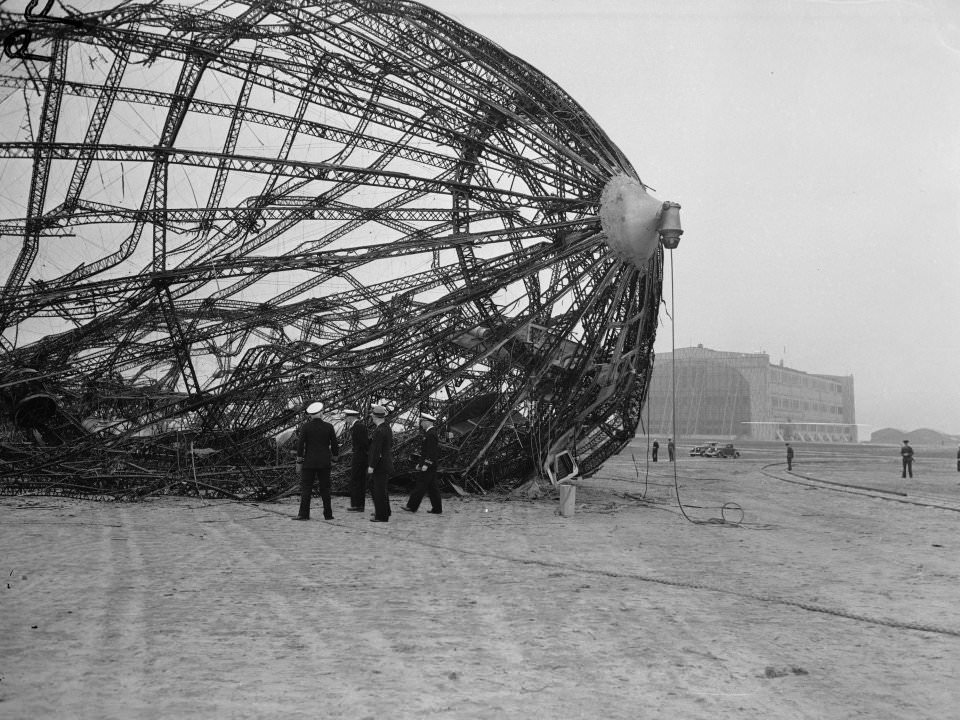
Twisted ribs of metal sprawl across the field where the LZ 129 Hindenburg once held its sleek, cigar-shaped form, leaving a skeletal hull that looks more like a collapsed cathedral than an airship. The framework bows inward, cables and struts tangled together, while a small cluster of uniformed onlookers stands near the wreckage, dwarfed by the scale of what remains. In the distance, large hangar-like buildings underline the setting’s purpose: this was a place built for flight, now turned into a scene of stunned inspection.
What makes this one of the last scenes feel so haunting is the quiet aftermath—no flames here, only structure and silence, and the slow work of understanding what happened. The Hindenburg disaster ended an era when rigid airships were marketed as a glamorous future of travel and engineering, and the photograph preserves that abrupt turning point in aviation history. Even without close-up drama, the image conveys the weight of a technological promise suddenly made fragile.
For readers drawn to inventions and the history of flight, this photo offers an unvarnished look at the material reality behind an icon: aluminum rings, bracing, and the complicated anatomy that kept a giant dirigible aloft. It’s a stark reminder that innovation is never just progress in motion; sometimes it’s also the lessons left behind on the ground. As a historical document, the wreckage of the LZ 129 Hindenburg remains one of the most recognizable symbols of airship travel’s dramatic end.