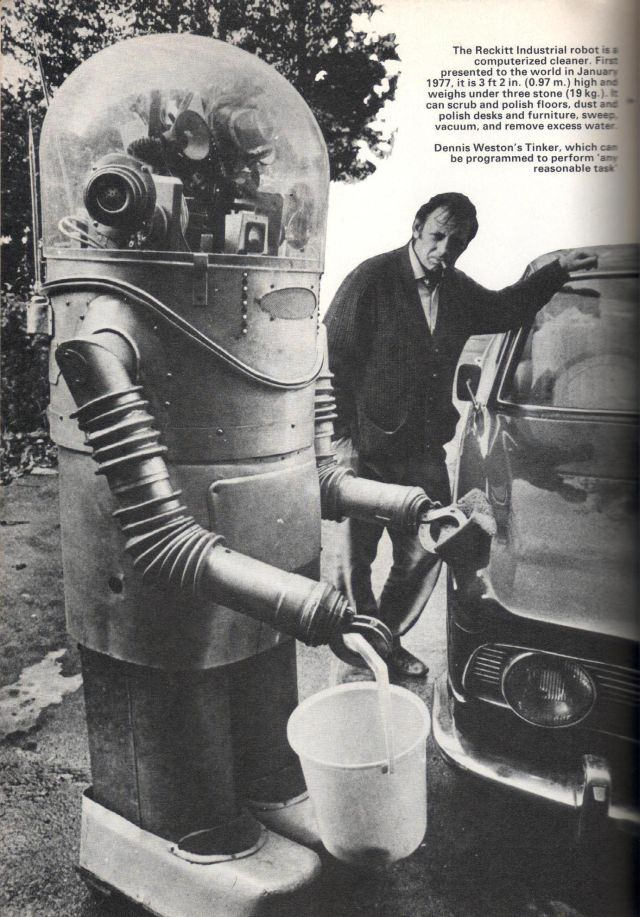
Bulky, riveted, and topped with a clear dome, “Tinker” stands like a mid-century promise made solid—part machine, part character—posed beside a car while a man looks on. The robot’s long corrugated arms and clamp-like hands are staged for work, holding a container as if ready to tackle the everyday chores that once defined the dream of automated domestic life. Even without motion, the photograph sells a familiar 1960s fantasy: a household helper built from industrial parts, meant to turn routine cleaning into the push-button future.
Printed text on the image reads like a product brief, describing the robot as a computerized cleaner designed to scrub and polish floors, dust, vacuum, and remove excess water, while also noting its size and weight. That language is telling—less science fiction than sales pitch—placing “home robot” in the same realm as appliances and labor-saving inventions. The mention that it could be programmed to perform “any reasonable task” reveals how the era measured intelligence: not by conversation, but by the ability to follow commands and reduce human effort.
Seen today, this 1966 vision of the future is as much about hopes and anxieties as it is about engineering. The staging beside a car and the careful listing of capabilities reflect a time when robotics was moving from factory imagination into public demonstration, inviting readers to picture machines in ordinary spaces. For anyone searching the history of household robots, vintage inventions, or early domestic automation, Tinker offers a vivid snapshot of how “the future” was marketed—practical, mechanical, and just plausible enough to feel close at hand.