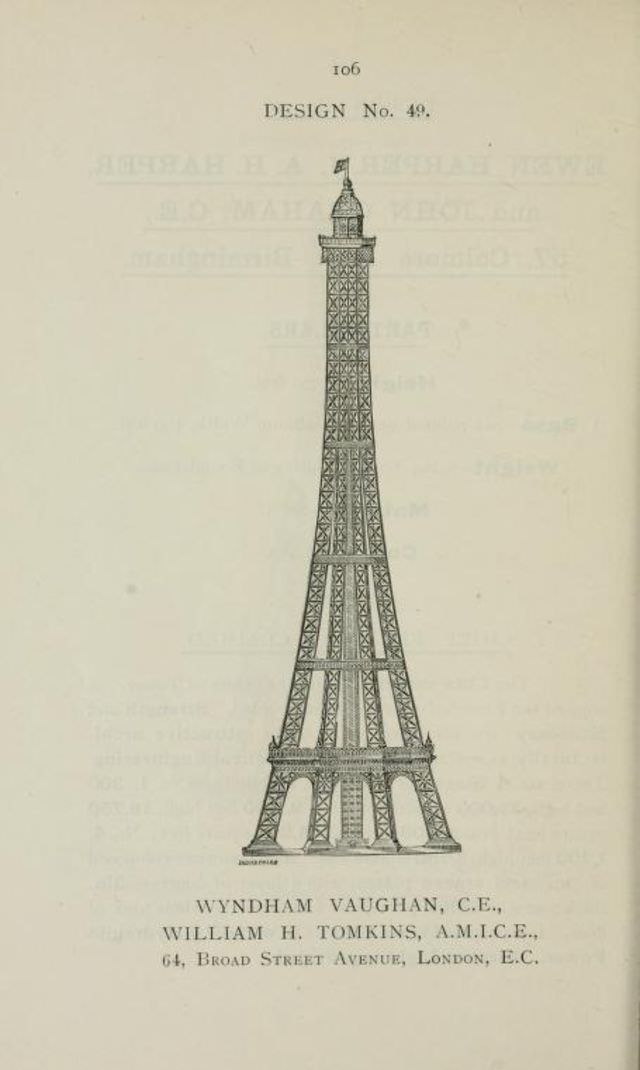
Page 106 labels it plainly—“DESIGN No. 49.”—yet the drawing aims for anything but ordinary. A slender iron lattice tower rises from a broad, arched base, narrowing as it climbs toward a capped lookout and a small flag at the summit. The engraving style and careful symmetry evoke the late-Victorian fascination with engineering elegance, when a single sheet of paper could sell the dream of a new skyline.
Beneath the structure, the credited names read “Wyndham Vaughan, C.E.” and “William H. Tomkins, A.M.I.C.E.,” along with an address on Broad Street Avenue, London, E.C., grounding this lofty proposal in the everyday world of offices and correspondence. The combination of airy trusswork, prominent lower arches, and a compact crown suggests a design meant to balance spectacle with structural logic—an invention as much for civic pride as for practical buildability.
Competition culture sits at the heart of this post: more than 50 rival submissions vying to define the “Great Tower for London” in 1890, each promising the city a modern monument. Seen today, Design No. 49 reads like a Victorian conversation with height, tourism, and technology, echoing the era’s appetite for ambitious projects and public marvels. For readers interested in London history, architectural competitions, and nineteenth-century engineering drawings, this image offers a crisp window into how big ideas were pitched, circulated, and imagined.