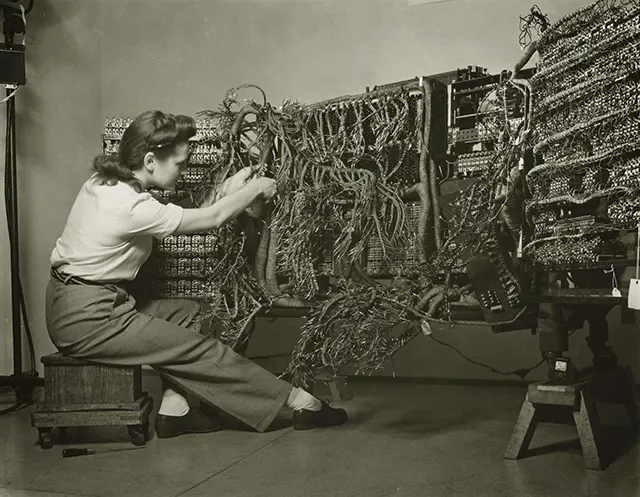
Leaning forward on a low wooden stool, a woman works with steady hands at the exposed “nervous system” of an early IBM computer, surrounded by dense bundles of cables and patch cords. The frame emphasizes the scale of the machine beside her—racks of components, open panels, and wiring that looks closer to a switchboard than the sleek hardware we associate with computing today. It’s an intimate view of invention in progress, where precision and patience mattered as much as theory.
Tangled wiring dominates the scene, but it isn’t chaos; it’s an organized complexity built one connection at a time. Early computing often relied on manual configuration—plugging, routing, and testing circuits to make a system perform a specific task—so technical labor like this was central to getting results. The photo quietly underlines how much hands-on craftsmanship went into “electronic brains” before integrated circuits and standardized interfaces simplified the work.
For readers interested in IBM history, women in computing, and the evolution of early computers, this photograph offers a vivid entry point into the era when programming could be physical and hardware maintenance was a daily reality. The plain workspace and utilitarian equipment keep attention on the process: careful wiring, close inspection, and the human expertise required to keep pioneering machines running. Seen today, it’s a reminder that technological breakthroughs were not only designed on paper—they were also built, wired, and verified in rooms like this.