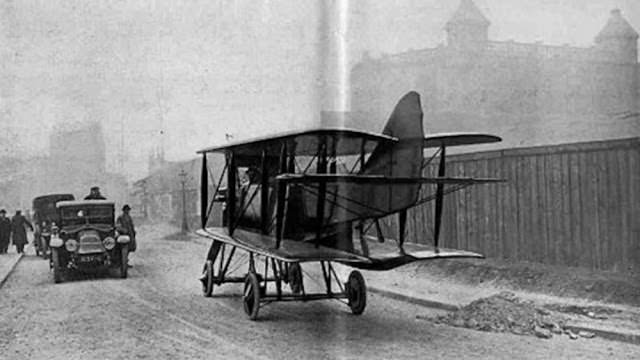
On a dusty roadway, Tampier’s Avion-Automobile rolls forward like a biplane that has wandered off the airfield, its stacked wings and slender tail towering over the modest wheels beneath. A driver sits exposed in the open frame while pedestrians and a conventional car behind provide a sense of scale, making the contraption’s odd proportions feel even more daring. The scene reads as a public trial run—part spectacle, part experiment—where everyday traffic briefly shares space with a vision of personal flight.
Early twentieth-century inventors were captivated by the idea of merging road and air travel, and this 1921 design sits squarely in that restless moment between the horse-and-carriage world and the age of mass aviation. The structure looks lightweight but intricate, with struts and rigging suggesting aircraft logic applied to street mobility, as if the machine were meant to transition from boulevard to runway with minimal fuss. Whether or not it ever truly delivered on that promise, the Avion-Automobile embodies the era’s confidence that engineering could compress distance and make tomorrow arrive faster.
For readers drawn to invention history, this historical photo offers a vivid glimpse of how futuristic ideas were tested in plain sight, amid ordinary buildings, fences, and unpaved roads. It also underscores a recurring theme in transportation history: progress often begins as something slightly awkward, highly impractical, and undeniably captivating. Seen today, Tampier’s Avion-Automobile stands as a memorable milestone in the long quest for a workable “flying car,” bridging imagination and machinery in a single, unforgettable silhouette.