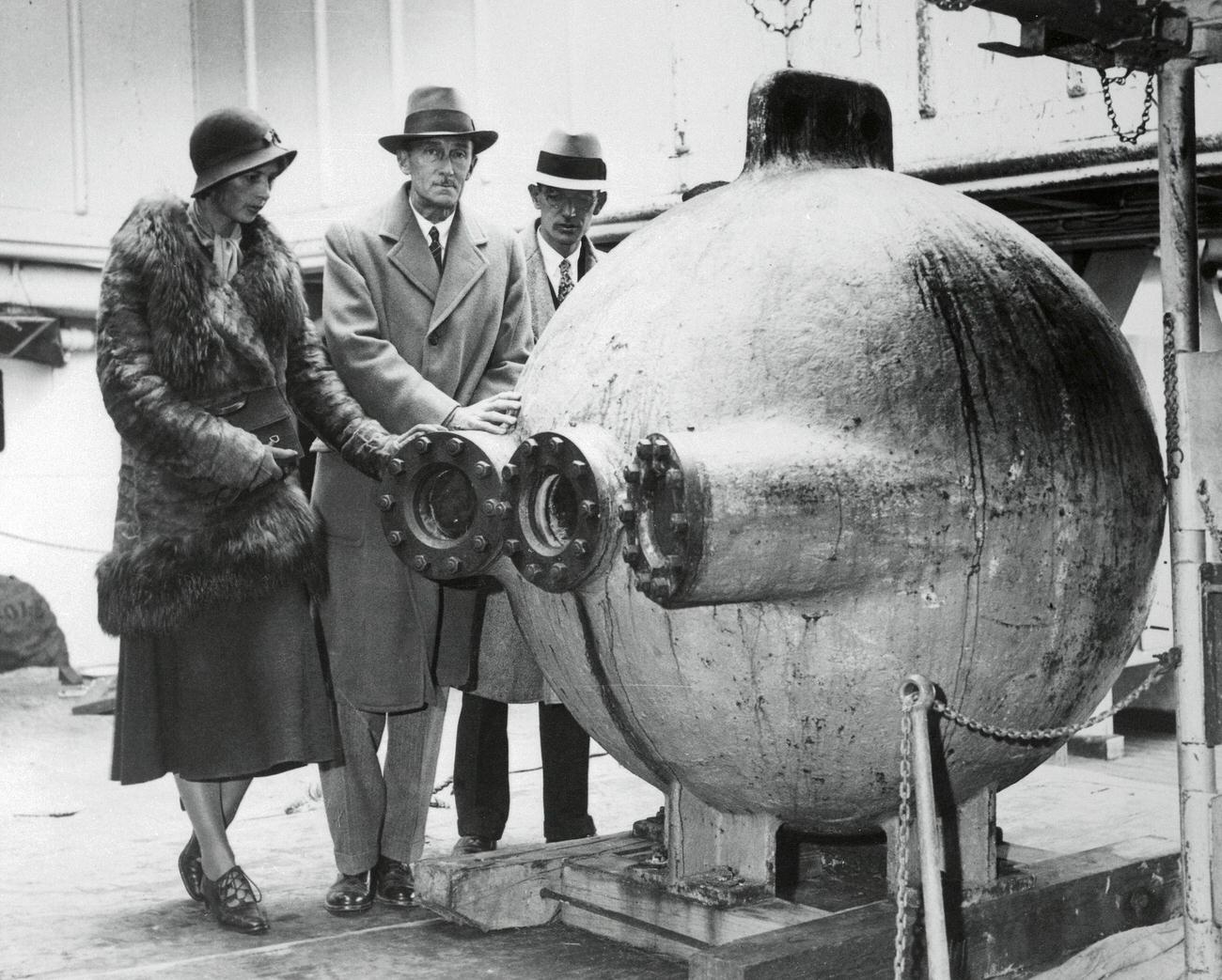
On a shipboard deck in 1930s New York, William Beebe stands beside the bathysphere with team members Gloria Hollister and John Teevan, their hands resting near the clustered viewing ports that made deep-ocean observation possible. The heavy steel sphere dominates the frame, its surface scuffed and streaked from handling, while chains and rigging overhead hint at the careful lifting and lowering required for each descent. Even in this quiet moment, the scene feels poised between laboratory precision and maritime grit.
Clothing and machinery share the spotlight: tailored coats, brimmed hats, and a fur wrap contrast sharply with the blunt industrial form of the submersible. The bathysphere’s rounded body and thick glass windows emphasize the era’s engineering confidence—build it strong enough, seal it tight, and the sea might briefly give up its secrets. Details like the bolted rings around each porthole serve as visual reminders that underwater exploration depended on meticulous craftsmanship as much as daring.
For readers drawn to the history of inventions and early oceanography, this photograph offers a compelling snapshot of a team-oriented milestone in deep-sea exploration. It captures the human scale of innovation—scientists and support staff meeting the immense, practical challenge of taking a person into the deep with only steel, glass, and cable as protection. As a piece of 1930s New York history, it also reflects how modern exploration was staged in working harbors, where experimental technology met the everyday world of ships and docks.