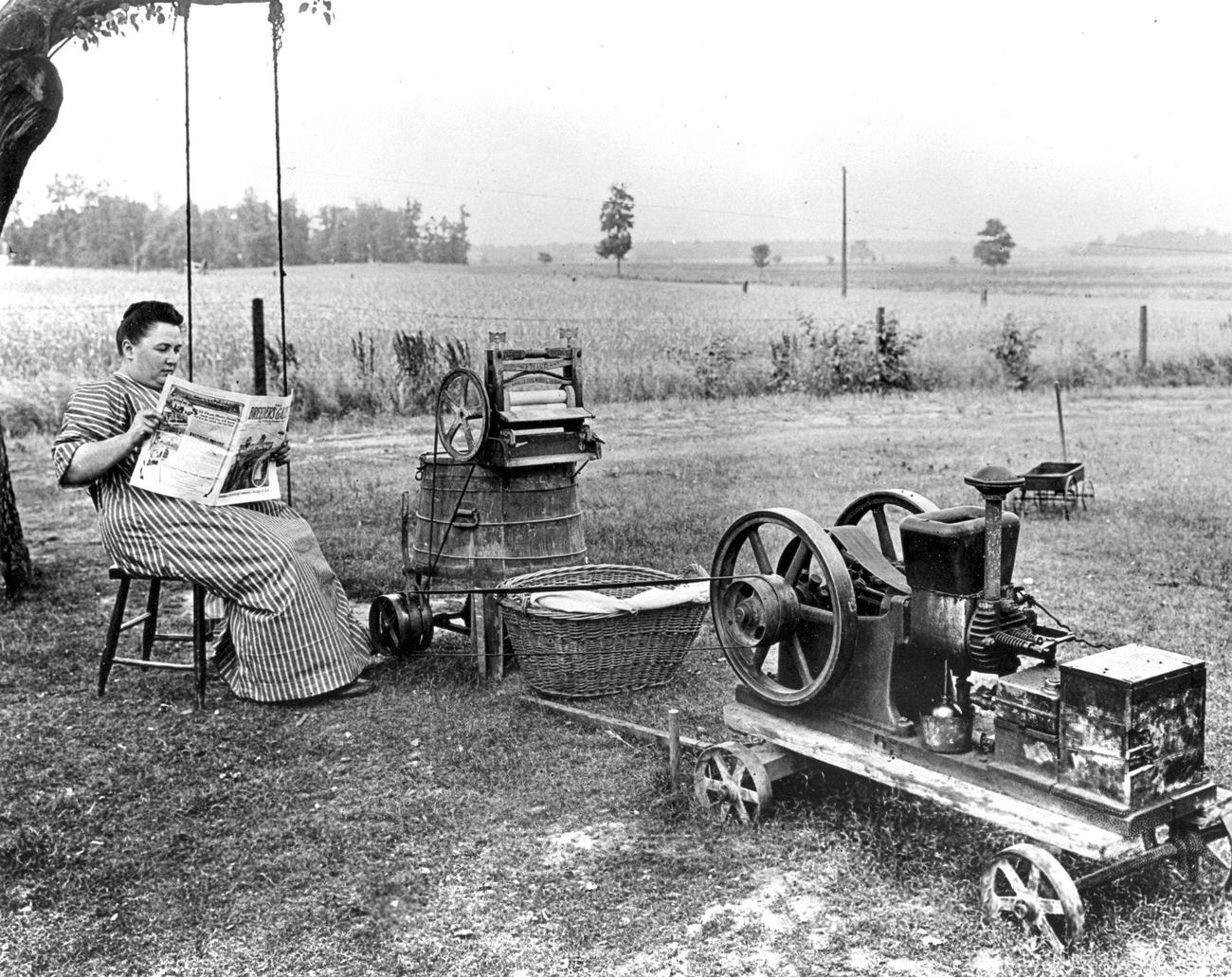
Under the shade of a roadside tree, a woman sits with a newspaper opened wide, composed and unhurried, while the day’s work waits at her side. The setting feels unmistakably rural—broad fields stretching to the horizon, a few fence posts and distant trees, and a small cluster of laundry tools arranged on the grass. Her striped dress, the plain chair, and the open air “workroom” evoke the practical rhythms of Midwestern life in 1914.
To her right stands a gas-powered washing machine setup that looks half farm implement, half household appliance: a compact engine on a wheeled base, a belt drive, and a wringer mounted above a tub. The heavy flywheels and exposed mechanisms hint at the noise, vibration, and smell of fuel that early home technology could bring, even as it promised relief from the backbreaking labor of washday. A wicker basket and nearby containers complete the scene, bridging old methods and new inventions in one frame.
What makes this photograph linger is the contrast between mechanized motion and human pause—reading beside a machine designed to hurry the task along. In an era when electricity was far from universal in the countryside, gasoline engines offered a portable kind of modernity, bringing “power” to the yard without wires. For anyone searching for early washing machines, rural domestic work, or everyday Midwestern history, this image offers a vivid glimpse of how innovation entered the household: not as sleek convenience, but as sturdy machinery shared with the open landscape.