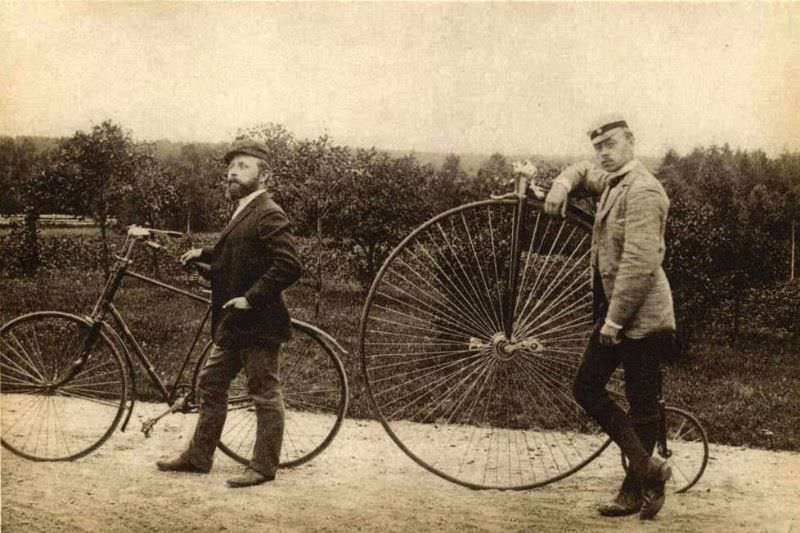
On a quiet country lane, two cyclists pause beside machines that look like engineering experiments brought to life. One stands with a more familiar “safety” bicycle, while the other leans casually on a towering penny-farthing, its enormous front wheel and tiny trailing wheel turning the rider into a silhouette of Victorian ambition. The rural backdrop and unhurried pose make the moment feel less like a staged studio portrait and more like a lived day out with new technology.
Penny-farthings were inventions as much as they were vehicles, built around a simple idea: speed through wheel size, since the pedals drove the front wheel directly. That design promised thrilling pace but demanded balance, strength, and nerve—especially on uneven roads where a sudden stop could pitch a rider forward. In photographs like this, the contrast between the high-wheeler and the lower, practical bicycle quietly marks a turning point in cycling history, when innovation began to favor comfort and safety as well as spectacle.
Details in clothing and posture deepen the story, hinting at the pride that early cyclists took in their machines and in the modern identity cycling offered. The penny-farthing’s spidery spokes, tall frame, and commanding stance speak to an era when inventions were worn in public like declarations of progress. For readers searching vintage cycling photographs, Victorian bicycle history, or the evolution from penny-farthing to modern bikes, this image captures the human scale of technological change—one roadside stop at a time.