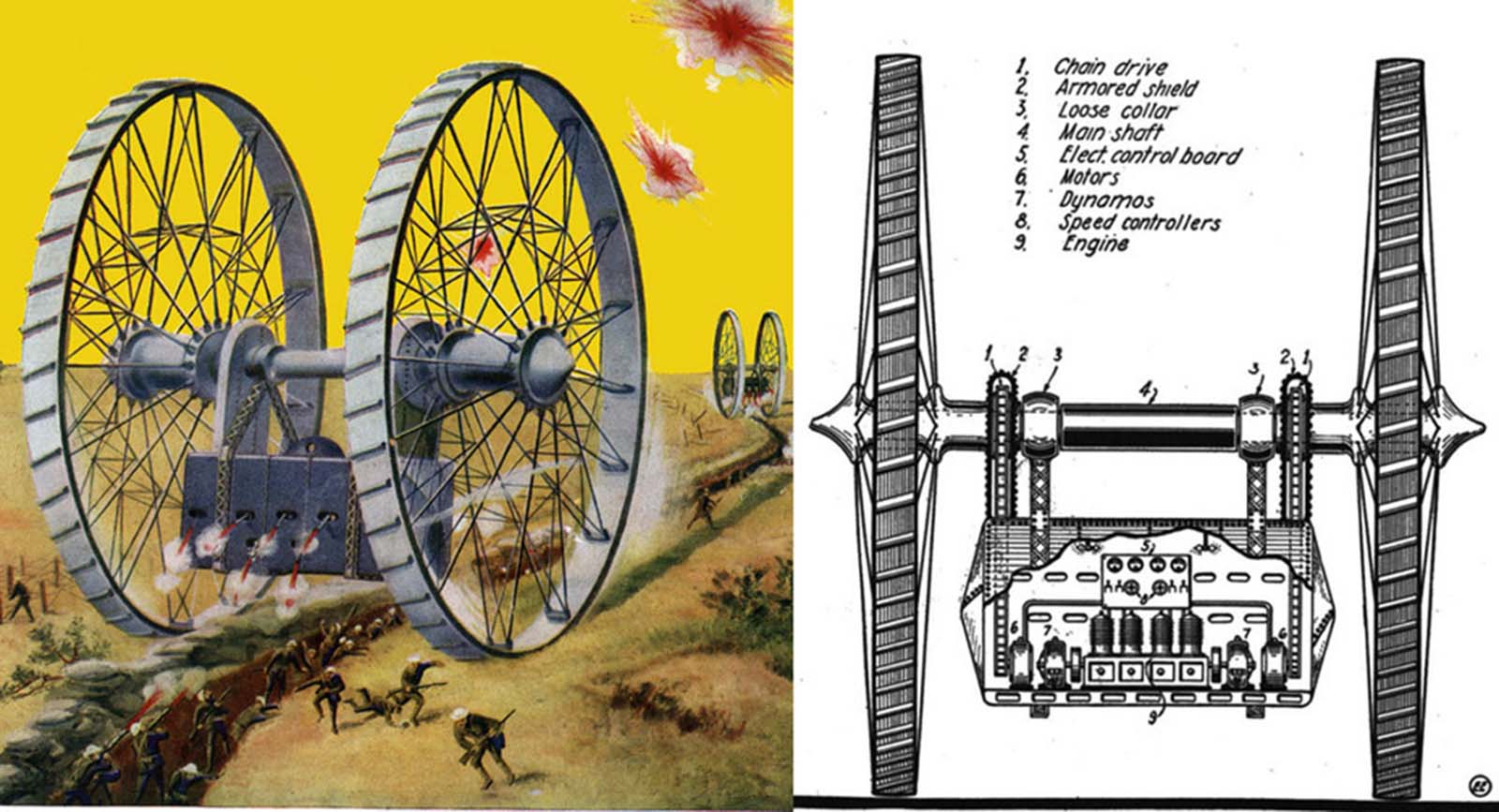
Hugo Gernsback’s “trench destroyer” leaps off the page as a bold piece of early military futurism, built around two towering spoked wheels that stride over broken ground like an industrial insect. In the colored scene, the machine rolls along a scarred battlefield, its low central body hanging between the rims while small figures below scatter amid smoke and bursts of fire. The sheer scale of those wheels suggests a solution aimed at one problem above all: crossing trenches and churned terrain that stopped ordinary vehicles cold.
Alongside the dramatic illustration, the accompanying technical drawing reads like a patent-minded blueprint, labeling a chain drive, armored shield, motors, dynamos, speed controllers, and an engine. That mix of electrical terminology with rugged mechanical parts hints at the era’s fascination with hybrid power and remote control, when inventors imagined electricity not just lighting cities but steering weapons. Even without a specific date printed here, the concept clearly belongs to the age of trench warfare, when new machines were proposed to break stalemates and reduce the vulnerability of infantry.
As a historical artifact, this image is less about a fielded weapon and more about the imagination of “Inventions” culture—magazines and popular science outlets that treated engineering as spectacle and hope. The trench destroyer embodies a recurring theme in early 20th-century design: outsized mobility, armored protection, and the belief that clever mechanics could outpace the horrors of modern war. For readers interested in Hugo Gernsback, early tank concepts, and speculative military technology, it’s a striking reminder of how quickly science fiction and practical engineering fed each other.