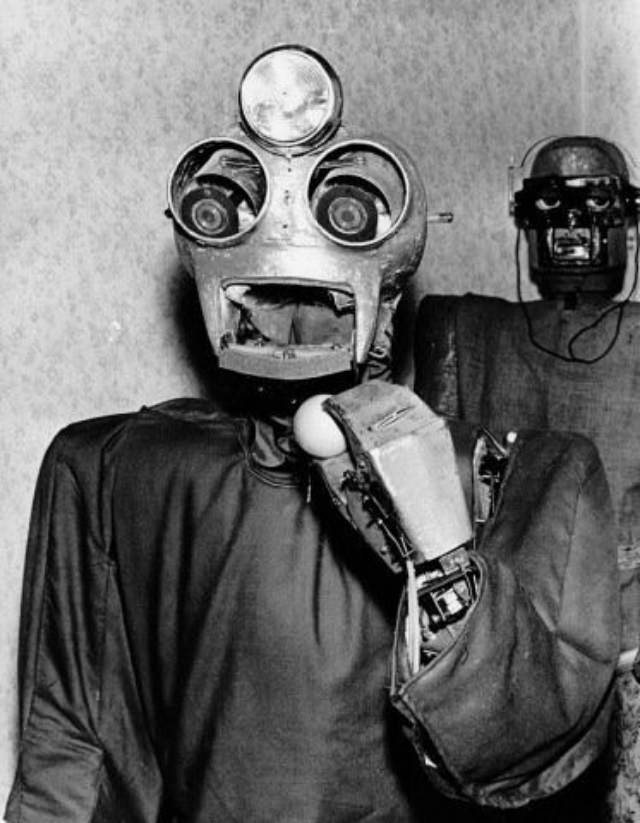
A bug-eyed metal face stares straight ahead, its oversized circular “eyes” and hinged mouth giving the machine an oddly theatrical expression. One articulated arm rises toward the head, ending in a gripper that holds a smooth, egg-shaped object, while fabric drapes over the torso like improvised clothing. Behind it, a second figure with a darker mask-like head and a boxy body stands watch, reinforcing the sense that this was as much a demonstration of possibilities as it was a practical trial.
The title points to Claus Scholz-Nauendorff’s MM7 Selektor Robot, a home-oriented invention imagined in an era when automation promised to transform everyday life. Rather than the sleek household robot of modern marketing, the design here feels experimental and hands-on—metal housings, visible joints, and a bold, almost cartoonish “face” meant to communicate function and intent to onlookers. That blend of engineering and stagecraft fits the long history of domestic technology, where public excitement often mattered as much as mechanical capability.
For readers interested in the early story of robots and housework, this historical photo offers a striking glimpse into how inventors tried to make machines seem helpful, approachable, and even a little human. Searchers looking for “MM7 Selektor Robot,” “Claus Scholz-Nauendorff invention,” or “vintage household robot” will recognize familiar themes: labor-saving dreams, prototype aesthetics, and the optimism that surrounded new devices. Seen today, the scene feels like a crossroads between science, spectacle, and the everyday chores innovators hoped to revolutionize.