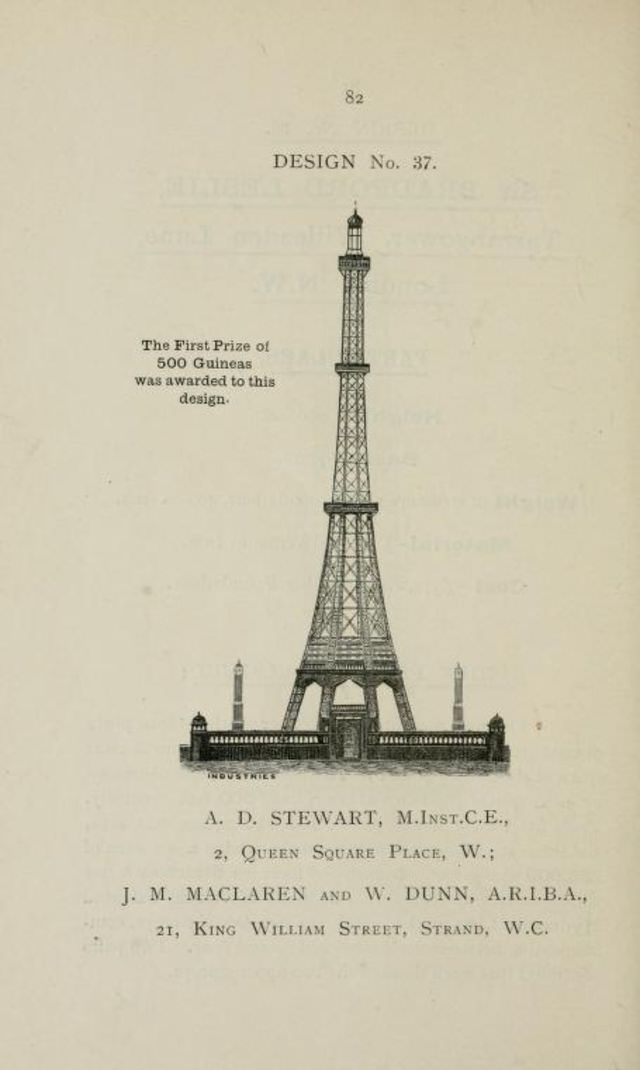
Perched on a printed page labeled “Design No. 37,” this ambitious proposal for a “Great Tower for London” rises in delicate linework, its latticed iron silhouette narrowing to a lantern-like crown. A note beside the drawing announces that the “First Prize of 500 Guineas was awarded to this design,” hinting at the fierce competition and public excitement surrounding late-19th-century feats of engineering. Even in miniature, the structure is presented as a landmark-to-be, complete with a formal base and flanking elements that give it the air of a grand exhibition monument.
The composition reads like a snapshot of Victorian-era invention culture, when bold architectural schemes were circulated through journals and catalogues for eager readers. Fine cross-bracing, stacked platforms, and a stout gateway at ground level suggest a tower meant not only to be seen from afar, but also to be entered, climbed, and experienced as modern spectacle. As with other era-defining projects, the drawing emphasizes vertical confidence—an assertion that iron, calculation, and ambition could reshape a city skyline.
Beneath the illustration, the page preserves the designers’ names and professional affiliations, grounding this futuristic vision in the practical world of engineers and architects competing for recognition. For anyone exploring “1890 inventions,” Victorian architecture, or the history of unbuilt London megastructures, the image offers an SEO-rich doorway into the age’s design contests and paper monuments. It’s a reminder that the past isn’t only made of what was constructed, but also of what was imagined—submitted, judged, and celebrated in ink.