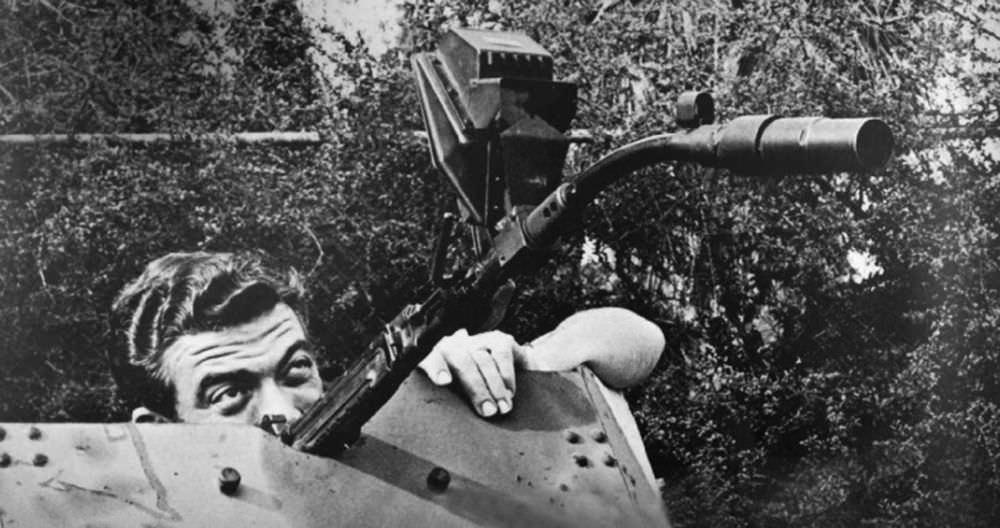
Peering over a slab of armor, a soldier steadies a rifle fitted with a strange, forward-jutting curve at the muzzle—an unsettling little hook of metal that hints at wartime improvisation. The scene feels like a field test as much as a photograph: dense foliage behind him, tension in his posture, and an apparatus that looks part weapon, part experiment. For readers searching WWII inventions, unusual small arms, or “bending bullets” technology, the Krummlauf concept sits right at the intersection of desperation and ingenuity.
The Krummlauf was designed to redirect fire around obstacles, offering the promise of shooting from behind cover or from awkward angles where a straight barrel couldn’t point. That idea—curving shots without exposing the shooter—made for dramatic propaganda and practical curiosity alike, even as the realities of pressure, wear, and reliability worked against it. In the photo, the add-on’s chunky profile and the mounted sighting equipment underscore how much engineering was being asked of a simple rifle barrel extension.
What lingers is the human scale of the experiment: one person, one weapon, and a bold attempt to rewrite the rules of ballistics in the middle of a global war. Whether viewed as a clever workaround or a technological dead end, the Krummlauf remains a compelling footnote in World War II military history—an example of how innovation often arrives wrapped in compromise. This post explores the story behind the curved barrel attachment, why it was pursued, and what the photograph reveals about the era’s frantic race for battlefield advantage.