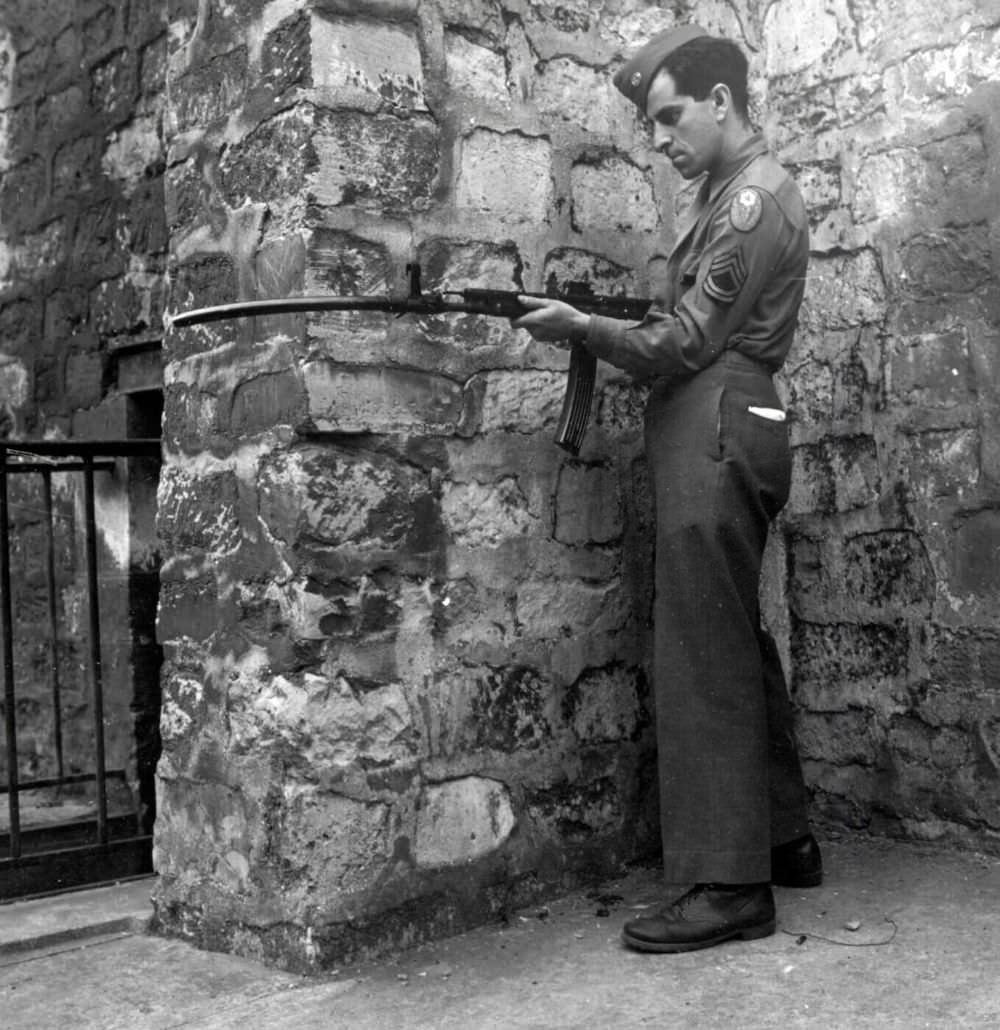
Pressed against a rough stone corner, a uniformed soldier steadies a rifle fitted with an oddly bent barrel, aiming where a straight shot shouldn’t be possible. The stark wall and tight angle do most of the storytelling here, turning an ordinary firing stance into a demonstration of wartime improvisation. It’s the kind of scene that instantly raises questions about how engineers tried to outsmart the geometry of street fighting.
Known from WWII lore as the Krummlauf, this experimental attachment was designed to redirect bullets around obstacles, offering a way to fire from cover or from within enclosed positions. The photo’s curved muzzle hints at the central problem: forcing a high-speed projectile to change direction without destroying accuracy—or the weapon itself. As a piece of military technology history, it sits at the crossroads of necessity, ingenuity, and the brutal practical limits of physics.
For readers interested in WWII inventions and rare weapons experiments, this image is a doorway into the astonishing “curved shot” concept and why it never became a standard solution. Beyond the novelty, it reflects a broader pattern of the era: rapid prototyping under pressure, field tests that bordered on the unbelievable, and ideas that were as daring as they were short-lived. Explore the story behind bending bullets, the engineering challenges, and the legacy of the Krummlauf in the wider history of wartime innovation.