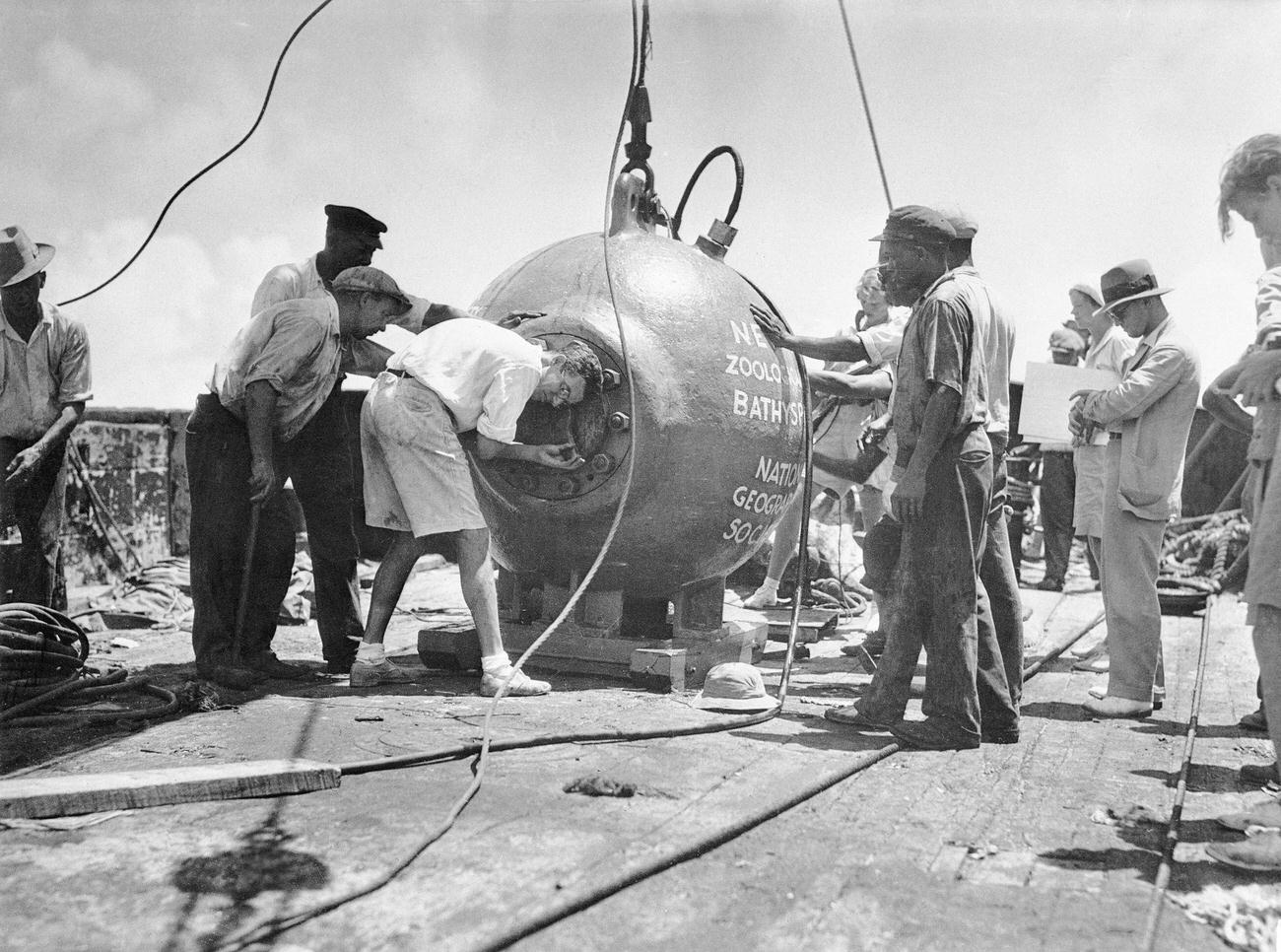
On a sunlit dock at Nonsuch Island, Bermuda, a steel sphere sits like a compact planet among coiled ropes and work-worn planks, its hoisting cable rising out of frame. John Teevan bends to the circular hatch, hands busy at the bolts and fittings, while a ring of onlookers and crew gather close—some steadying the hull, others watching with the patient attention of people who know the smallest detail can matter. Painted lettering on the bathysphere’s side turns the object into a statement as well as a machine, tying it to organized science and the promise of deep-sea discovery.
The bathysphere used by William Beebe was an invention built for extremes, and this moment—opening it back up to daylight—quietly underscores what such technology demanded. The heavy, rounded form suggests pressure resistance and containment; the hatch and fasteners hint at the ritual of sealing and unsealing a world meant to travel where humans cannot. Around it, the mix of practical clothing, hats, and purposeful postures conveys a field operation rather than a laboratory, with ocean air and improvised workspace standing in for polished benches.
For readers drawn to the history of underwater exploration, early marine research, and pioneering scientific instruments, this photograph offers a grounded, human-scale look at the bathysphere era. It’s a reminder that breakthroughs were not only dramatic descents but also the careful teamwork on the surface—preparing, checking, opening, and learning from each run. In the story of Bermuda’s research outposts and the National Geographic–linked deep-sea experiments, Teevan’s hands at the hatch mark the practical hinge between invention and discovery.