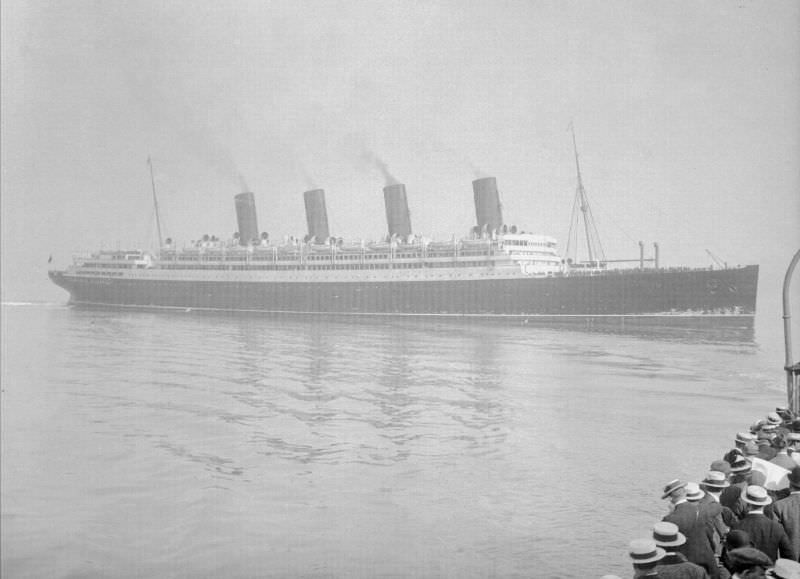
Misty light softens the outlines of the great liner Aquitania as she lies off Fishguard, her long dark hull mirrored in calm water while a row of tall funnels punctuates the pale sky. Along the edge of the tender in the foreground, passengers in brimmed hats press close together, leaning outward for one more look at the new arrival. The scene carries the hush of early morning at sea, when distance and fog turn even enormous machinery into something dreamlike.
Seen from the smaller vessel, the scale of Aquitania becomes the story: decks stacked high, railings traced with tiny figures, and clean lines that speak to early twentieth-century ocean travel at its most ambitious. The title’s “maiden call” frames this as a moment of introduction and curiosity—an encounter between a Welsh port and a transatlantic ship built to impress. Details like the crowding at the rail suggest the quiet theater of arrival and departure, as if everyone aboard understands they are witnessing a headline made tangible.
For anyone searching for maritime history, Edwardian travel, or the Cunard liner Aquitania, this photograph offers a textured glimpse of June 16, 1914, when modern engineering and human emotion met on the water. Fishguard appears not as a backdrop but as a threshold, a place where ocean routes connected local horizons to wider worlds. The tender’s passengers, half-silhouetted against the fog, remind us that even in an age of grand ships, the lasting memory is often the last look back.