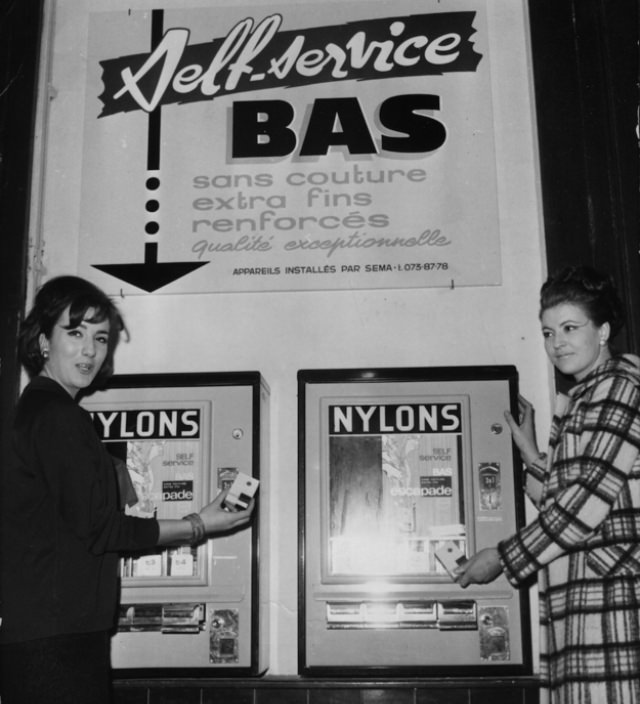
Under a bold sign reading “Self-service BAS,” two wall-mounted machines offer an unexpected kind of convenience: nylons dispensed like everyday essentials. The French wording—“sans couture,” “extra fins,” “renforcés,” and “qualité exceptionnelle”—leans on the familiar promises of comfort, delicacy, and durability, translating the language of fashion into the language of modern retail. Even the oversized arrow feels like part of the sales pitch, directing passersby toward an on-the-spot solution.
On either side, two women pause at the dispensers, one holding a small boxed purchase while the other reaches toward the controls, as if demonstrating how quick the transaction can be. The scene sits at the intersection of street life and personal wardrobe, where a snag, a run, or an overlooked errand could be remedied without a trip to a boutique. With “NYLONS” printed large across each unit, the machines make their purpose unmistakable and turn hosiery into something you can buy in seconds.
For anyone interested in inventions and everyday technology, this snapshot from France highlights how self-service culture reshaped shopping habits beyond food and cigarettes. Pantyhose on-the-go speaks to a period when synthetic fabrics and automated vending both carried a whiff of progress, promising efficiency and a touch of glamour. It’s a small reminder that history often lives in the practical details—what people needed, how businesses sold it, and the ingenious ways cities tried to keep pace.