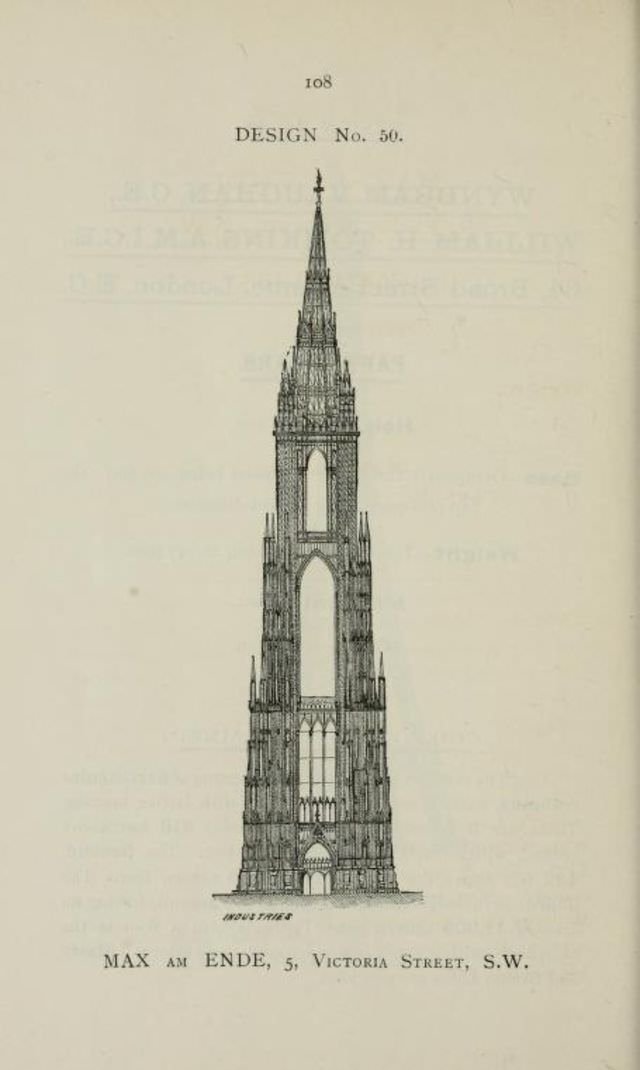
Design No. 50 rises like a needle of ambition, a slender Gothic-inspired tower rendered with crisp linework and stacked arches that pull the eye upward. The drawing’s dramatic verticality, open tracery, and tiered spire suggest an era captivated by height, spectacle, and the promise of modern engineering dressed in historic forms. Even on the page, it reads as a proposal meant to impress—part cathedral silhouette, part exhibition monument.
Across London in 1890, the idea of a “Great Tower” sparked a wave of competitive designs, and this entry hints at the inventive fervor behind that brief architectural contest. Submitted plans often balanced practicality with civic showmanship, offering bold profiles that could redefine the skyline and symbolize progress. Here, the composition emphasizes symmetry and soaring voids, as though the architect wanted the structure to feel both massive and surprisingly light.
At the bottom, the printed credit “MAX AM ENDE, 5, Victoria Street, S.W.” anchors the concept to a real submission rather than a mere fantasy sketch. For readers interested in Victorian inventions, unbuilt London landmarks, and the history of architectural competitions, this illustration offers a fascinating glimpse into what might have been. It’s a reminder that the late nineteenth century wasn’t just building new structures—it was also building new dreams, one numbered design at a time.