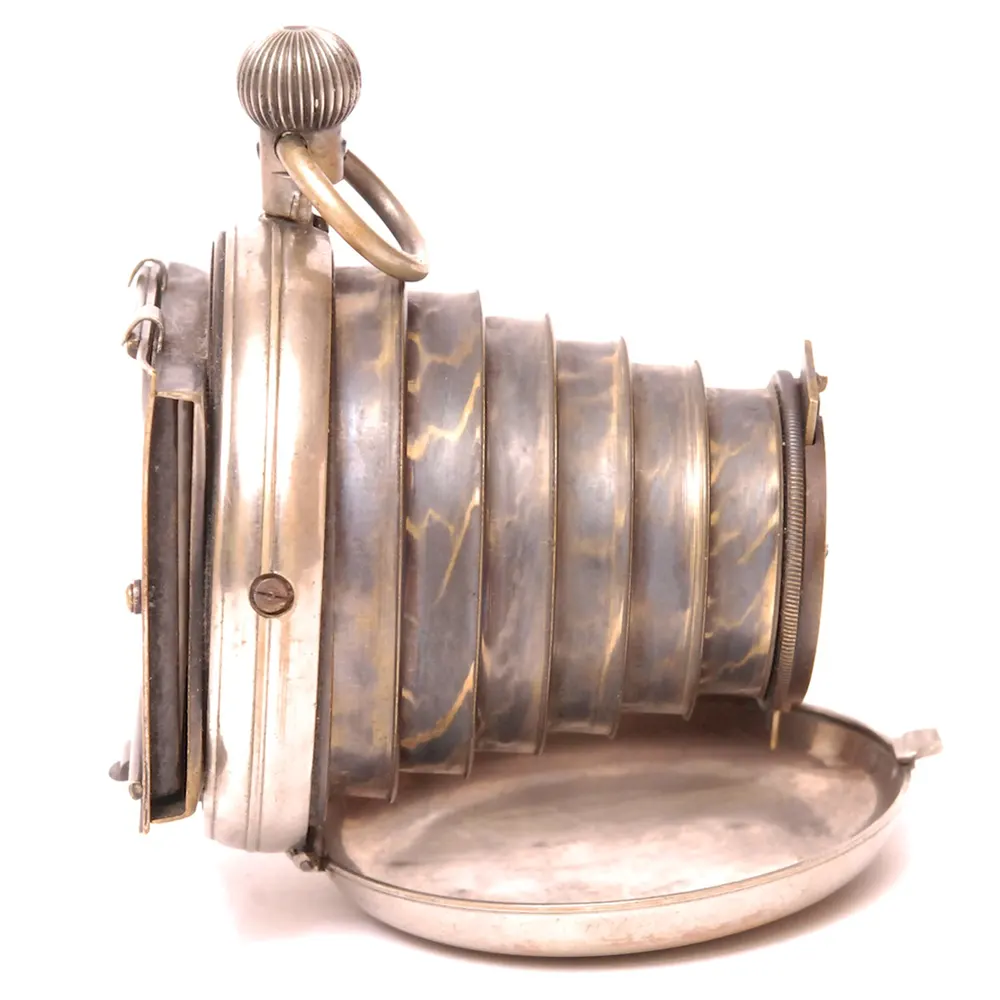
Brass and steel gleam in this close view of the Lancaster Watch Camera, where a compact body meets a distinctive bellows lens that telescopes outward like a miniature accordion. A knurled knob and ring hardware hint at watchmaking DNA—precision controls scaled down for the pocket—while the hinged metal base reads as both protective cover and improvised support when the device is set down to work.
Victorian inventors loved disguises, and this clever “watch” camera sits squarely in that tradition of everyday objects turned into instruments of observation. The design suggests quick handling and concealment: a small form, a simple grip, and a lens assembly that could be extended for the shot and tucked away again, feeding the era’s fascination with candid photography, novelty gadgets, and the early promise of portable imaging.
Alongside bicycles, phonographs, and other late-19th-century marvels, the 1893 Lancaster Watch Camera reminds us how rapidly technology was shrinking—and how social habits were changing with it. For historians and collectors of antique cameras, spy cameras, and Victorian inventions, the photo invites a closer look at materials, mechanics, and the subtle aesthetics of industrial craftsmanship that made discreet photography feel both modern and slightly mischievous.