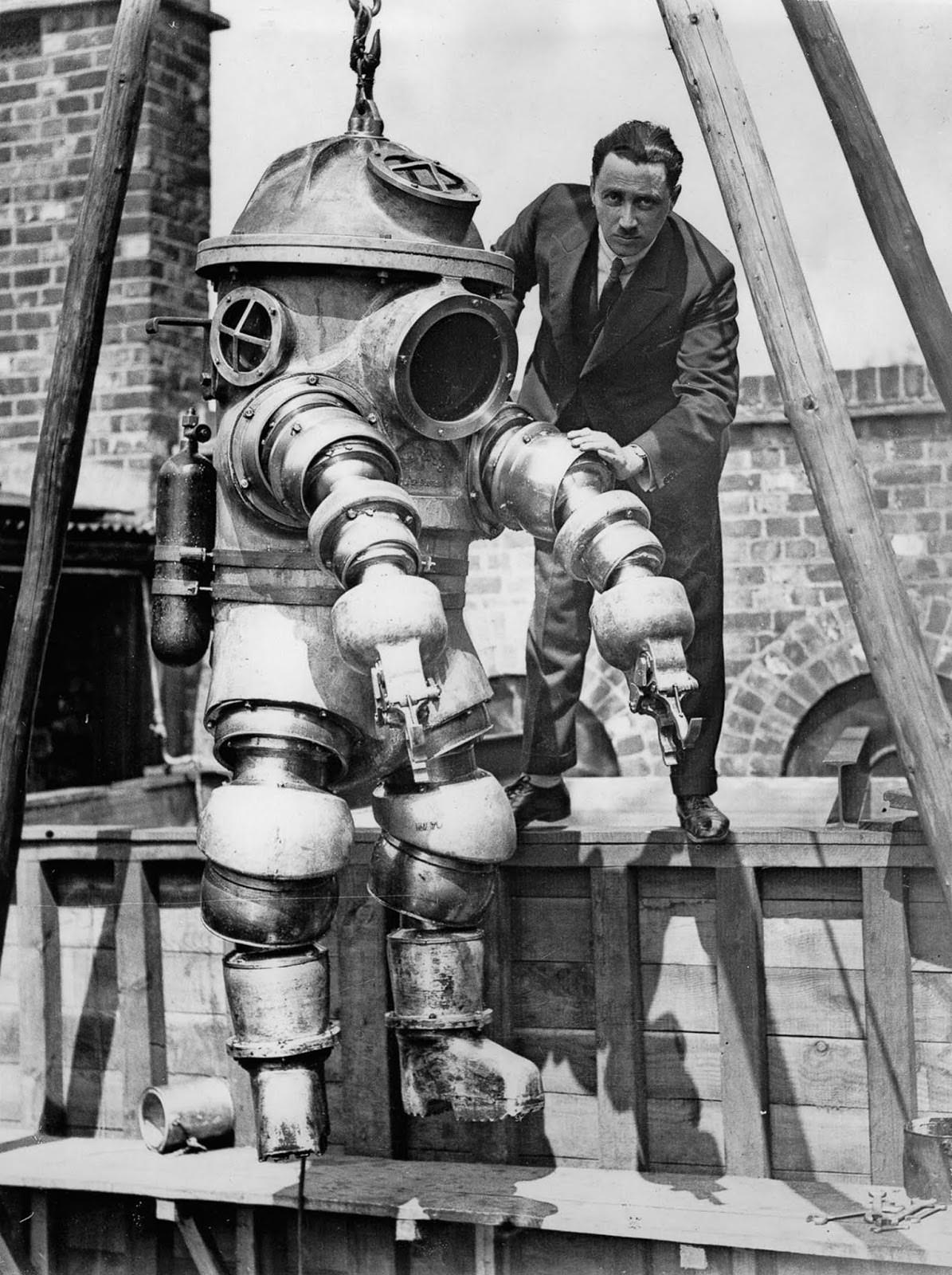
Steel, rivets, and a pair of oversized jointed arms dominate the frame as J.S. Peress prepares his new armored diving suit for trials in a tank at Weybridge, United Kingdom, in 1930. Suspended from a hoist, the heavy helmet and thick torso plating look more like industrial machinery than clothing, with round porthole-style windows suggesting the limited, precious view a diver would have once sealed inside. Peress stands close, dressed in a suit and tie, his hand on the apparatus as if steadying both the invention and the moment.
The engineering details reward a longer look: articulated shoulders and elbows designed to move under pressure, massive boots built for stability, and external fittings that hint at air supply and control systems. Nearby wooden timbers, brick walls, and the testing setup underline that this is experimental work—prototype hardware being handled, adjusted, and judged before it ever meets open water. The contrast between polished metal and worksite surroundings captures the practical reality of early twentieth-century innovation.
In an era fascinated by deep-sea exploration and the promise of new technologies, an armored diving suit represented more than novelty; it was a bid to extend human reach into hostile environments. Images like this one help tell the story of underwater engineering between the wars, when inventors pushed materials and mechanics to protect the body from depth and pressure. For readers interested in inventions, vintage technology, and the history of diving equipment, Peress’s test at Weybridge offers a striking snapshot of ambition made tangible.