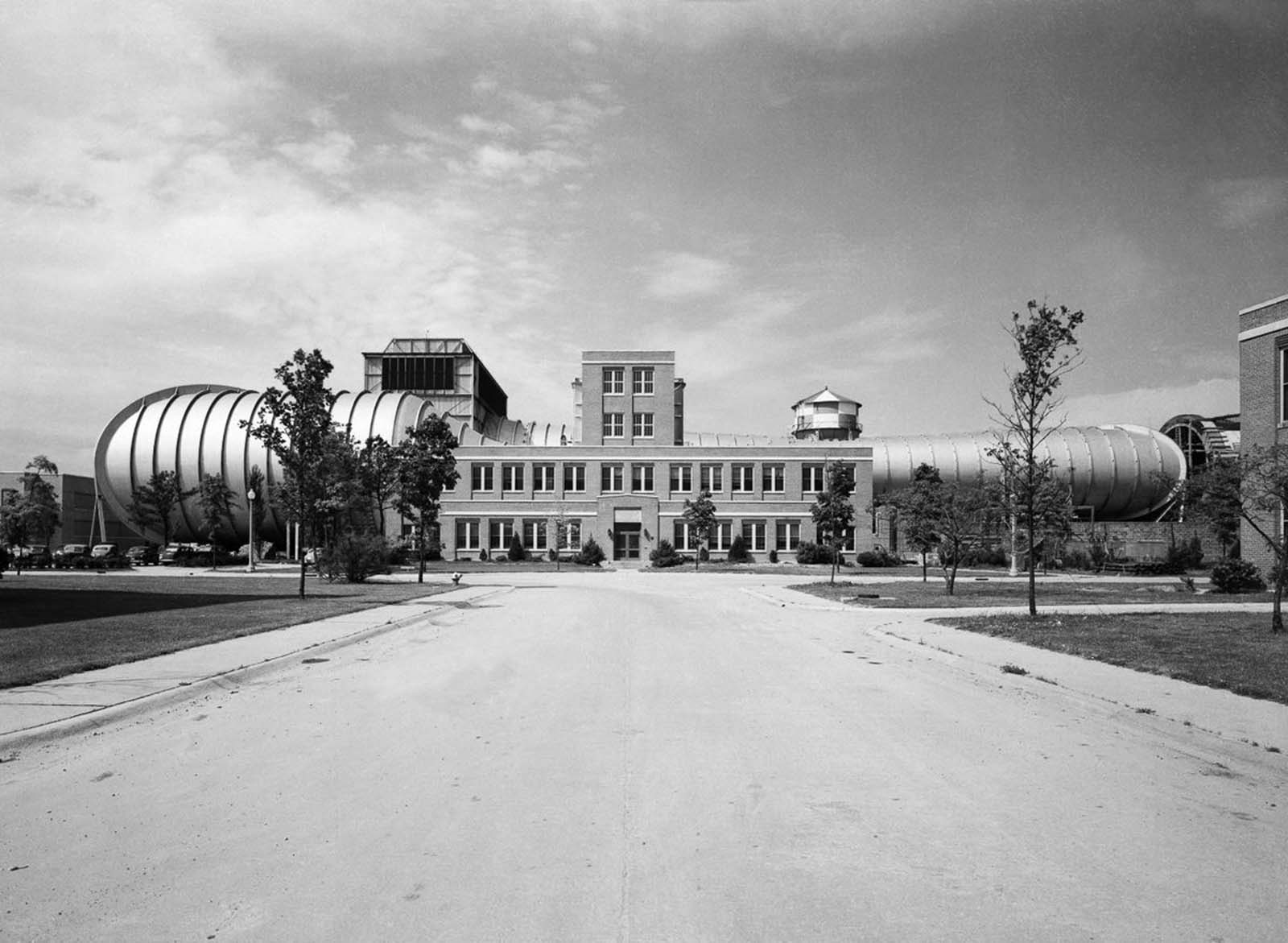
Rising behind a tidy administrative façade, the immense cylindrical housing of the 16-foot High Speed Tunnel dominates the scene at Langley Research Center in 1949, its ribbed metal skin stretching across the campus like an industrial backbone. A broad, empty roadway leads the eye straight to the building’s centered entrance, while young trees and clipped lawns soften the hard geometry of brick and steel. The composition feels deliberately orderly, a visual promise that modern flight could be made predictable through careful measurement.
Built for experimentation rather than spectacle, a high-speed wind tunnel like this was the kind of invention that turned air into a laboratory instrument. Inside, engineers could drive controlled streams of air past test models and components to study lift, drag, stability, and the troublesome effects that appear as speeds climb. The tunnel’s scale—signaled in the title by that “16-foot” dimension—hints at the ambition of postwar aeronautical research: larger test sections, higher speeds, and data precise enough to guide real-world design choices.
For readers interested in NASA history and the evolution of American aeronautics, this photograph captures a pivotal research landscape where architecture and engineering meet. The juxtaposition of a conventional office block with the giant tubular structure underscores how breakthrough technology was often housed in surprisingly everyday settings. As a piece of aviation heritage, the 16-foot High Speed Tunnel stands as a reminder that the path to faster aircraft and safer flight ran through facilities like Langley—quiet, methodical, and built to make the invisible forces of air visible on paper.