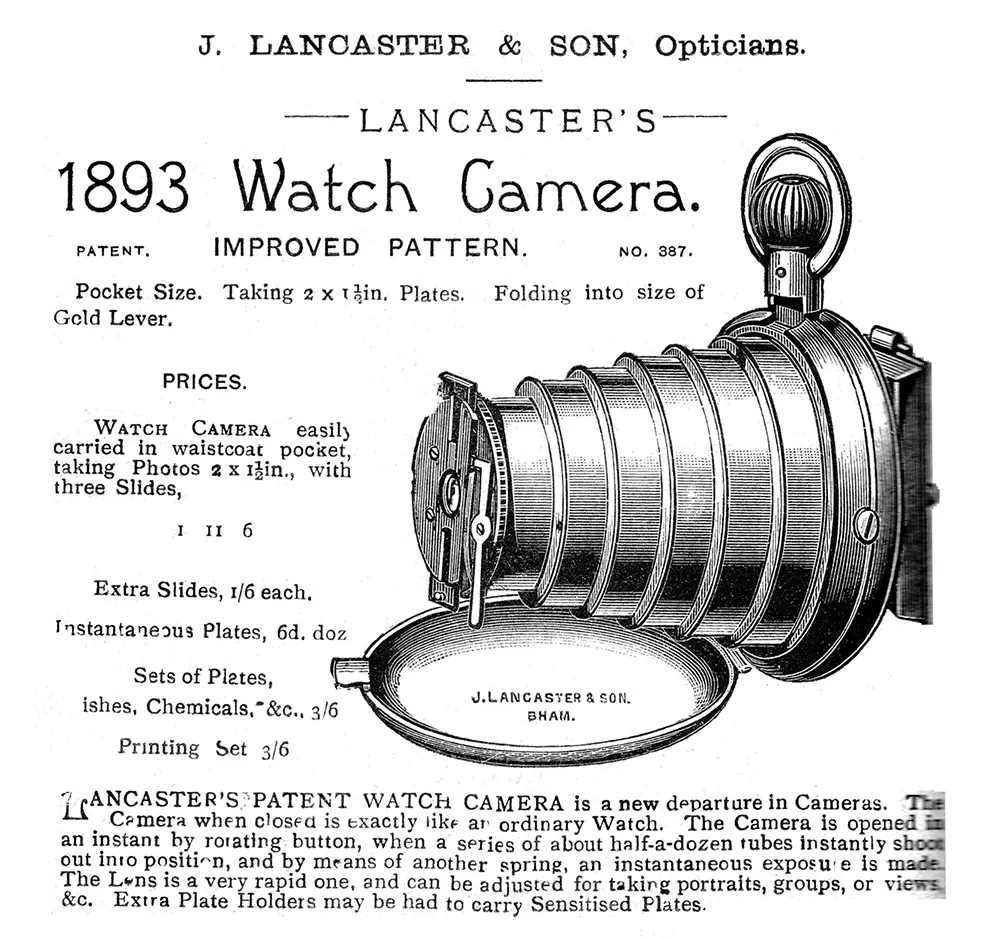
Victorian advertising rarely hid its confidence, and the bold typography here makes a promise of modern magic: a “1893 Watch Camera” from J. Lancaster & Son, opticians. The engraving pairs dense product copy with a crisp technical illustration, inviting the viewer to imagine photography not as a studio ritual but as something that could be folded up and slipped into everyday life. Even at a glance, the page reads like a gateway into the late-19th-century marketplace where precision instruments were sold with equal parts practicality and wonder.
At the center, the camera itself looks like a compact watch transformed—ribbed, cylindrical sections suggesting a clever, collapsible body, topped with a loop like a pocket watch’s bow. The text emphasizes its pocket size and the use of small plates, reinforcing the idea of discreet image-making in an era when most cameras were still conspicuously boxy and slow. For anyone searching terms like “Lancaster watch camera,” “Victorian spy camera,” or “pocket camera invention,” this artifact captures the moment when portability became a selling point—and discretion became a thrill.
Beyond the gadgetry, the advertisement hints at shifting social habits: photographs moving out of formal sittings and into streets, gatherings, and private curiosities. Phrases about easy carriage in a waistcoat pocket and rapid exposure underline a new kind of spontaneity, powered by mechanical ingenuity and consumer desire. Seen today, the 1893 Lancaster Watch Camera stands as both a marvel of design and an early reminder that the urge to make images—quickly, quietly, and anywhere—has deep historical roots.