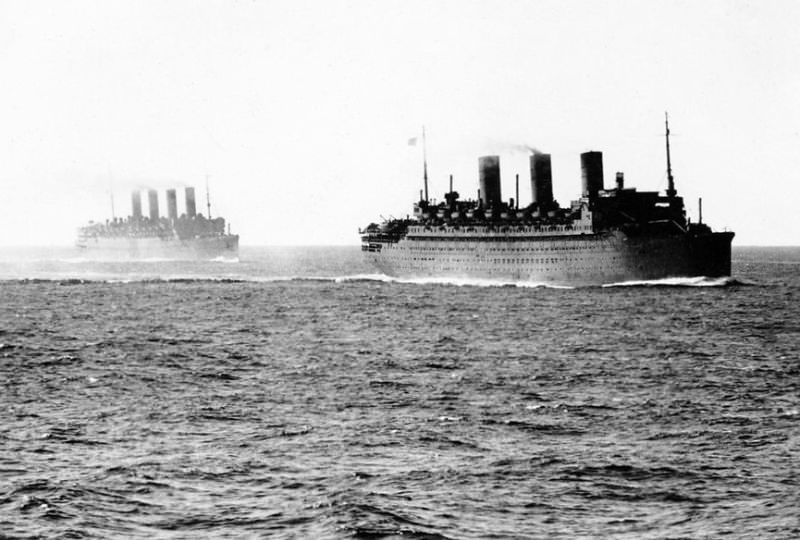
Low on the horizon, two great ocean liners cut across a grey, wind-ruffled sea, their long hulls and tall funnels unmistakable silhouettes from the golden age of transatlantic travel. The nearer ship drives forward with a frothy bow wave, while her companion trails behind in the haze, giving the scene a sense of distance, speed, and purpose. Even in this stark wartime view, the liners’ scale and layered decks hint at their former lives as floating palaces.
By 1943, Aquitania and Île de France were no longer simply passenger liners but working ships shaped by the demands of World War II, and the title links them to Operation Pamphlet. That operation is remembered for moving large numbers of troops across oceans, and the photograph’s open-water setting suits the story: long voyages, convoy discipline, and ships built for comfort pressed into service for logistics. The contrast between the smooth superstructure and the restless surface below quietly underscores the tension between maritime glamour and wartime necessity.
For readers interested in naval history, troopship conversions, or the broader history of Allied transportation, this image offers a clean, atmospheric snapshot of how civilian technology was repurposed at scale. The absence of close-up detail makes the composition feel almost cinematic, letting the viewer focus on form, movement, and the shared direction of two iconic liners at sea. As a historical photo of Aquitania and Île de France during Operation Pamphlet, it anchors a larger conversation about ships, strategy, and the human journeys carried within steel hulls.