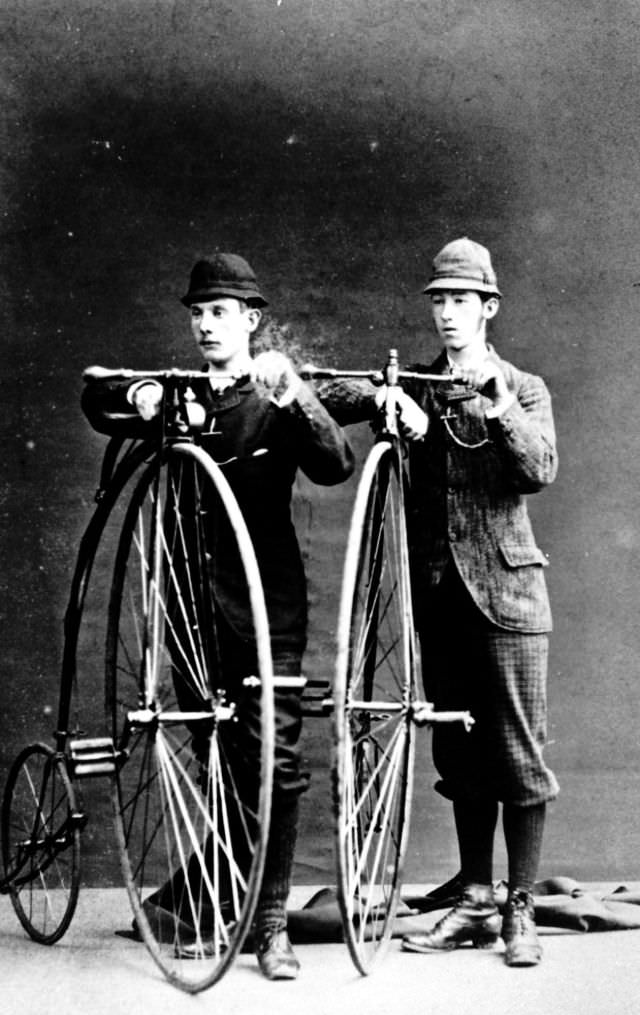
Two young cyclists pose with the towering elegance of a penny-farthing, its oversized front wheel rising like a piece of moving architecture against a plain studio backdrop. Their period clothing—caps, tailored jackets, and sturdy boots—adds to the sense that cycling was as much a public performance as a practical way to travel. Even in a simple portrait, the high-wheeler’s scale and slender frame announce an age when balance, nerve, and mechanical curiosity went hand in hand.
Leaning casually across the handlebar, the riders draw attention to the bicycle’s defining inventions: direct-drive pedaling on the huge front wheel, the tiny trailing wheel for stability, and the skeletal network of spokes built for speed and lightness. The upright stance and narrow saddle hint at the distinctive riding technique required, while the long fork and minimalist fittings show how early designers pursued efficiency with the materials and knowledge available. For readers searching for penny-farthing history, vintage cycling photographs, or early bicycle design, details like these are the story in metal and rubber.
Beyond the novelty, the photograph speaks to a turning point in everyday life, when personal mobility began to feel modern and self-directed. High-wheel bicycles helped popularize the idea that a person could cover distance quickly under their own power, inspiring new fashions, pastimes, and a growing fascination with engineering. The result is a timeless glimpse of the penny-farthing era—part sport, part invention, and part social statement—preserved in a single, unforgettable image.