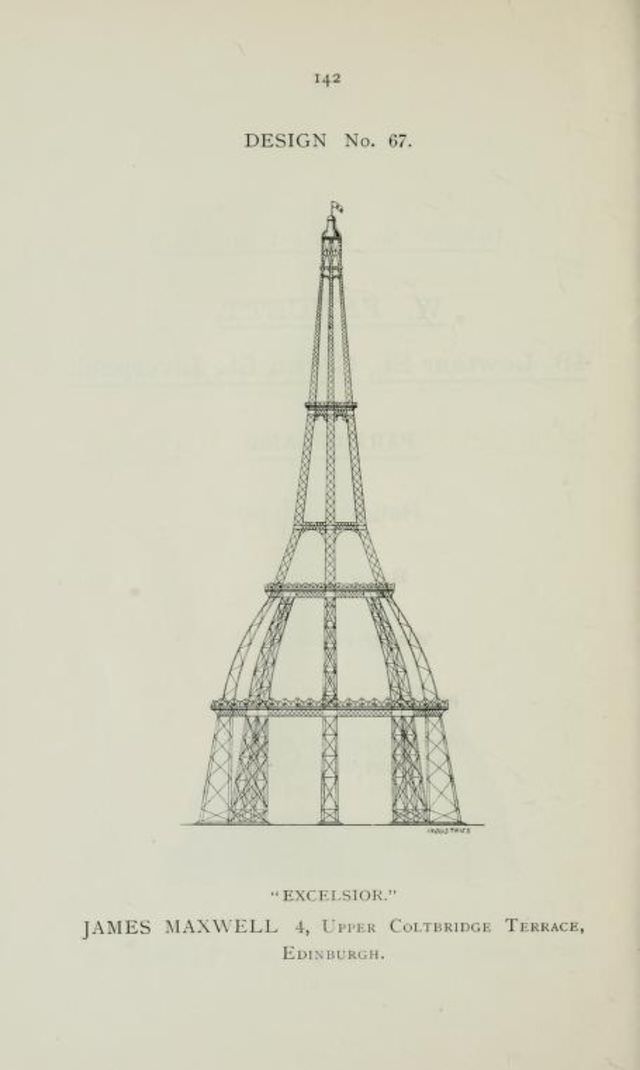
Ambition leaps off the page in this slender tower proposal labeled “Design No. 67,” a crisp line drawing from the burst of competitive ideas for a Great Tower for London around 1890. The concept rises in stacked stages, narrowing as it climbs, and it’s rendered with the careful, technical confidence of late-Victorian engineering culture—part blueprint, part sales pitch for the future.
Delicate latticework and bold bracing suggest a structure meant to be both light and strong, with broad arches at the base transitioning into a rigid, tapering spine. The draughtsman’s emphasis on symmetry and repeating geometric patterns hints at the era’s fascination with iron frameworks and exhibition-era spectacle, when monumental height became a way to advertise modernity as much as to provide utility.
Printed beneath the drawing, the motto “Excelsior” and the entrant’s details anchor the design in the practical world of submissions, committees, and public competitions, where dozens of visions jostled for attention. For readers exploring 1890 inventions and Victorian architectural proposals, this image is a small window into how London’s imagined skyline was negotiated on paper—through inventive forms, persuasive presentation, and an unwavering belief that the next big structure could redefine a city.