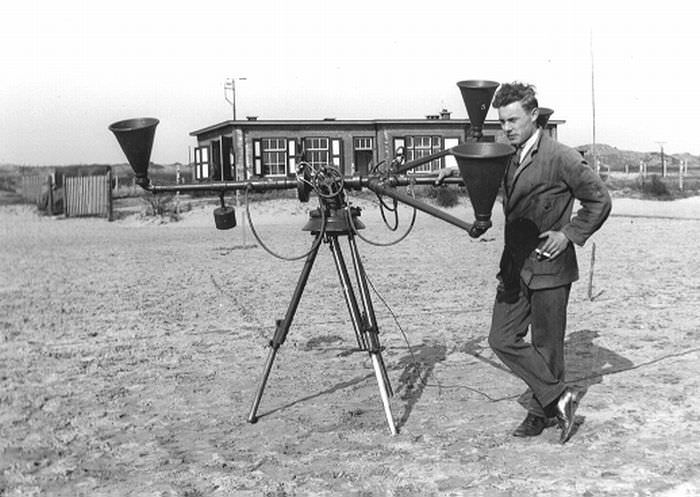
Set on a bare, sandy training ground, Askania’s Doppelt Richtungshörer dominates the scene like a mechanical insect—two long arms stretching left and right, each tipped with flared acoustic horns. The apparatus sits on a sturdy tripod, bristling with joints, cables, and adjustment knobs, built for careful aiming rather than quick improvisation. In the background, a low utilitarian building and fence lines hint at a test range or airfield environment where new equipment could be tried under open skies.
Beside the instrument stands a suited operator, posed with the calm familiarity of someone used to precision hardware, cigarette in hand and eyes turned toward the device. The scale is striking: the “double direction listener” is not a handheld gadget but a full-fledged installation, suggesting how seriously engineers took the problem of locating distant sound. Before radar became widespread, acoustic listening devices like this promised a way to detect and track aircraft by ear, translating faint noise into measurable direction.
What makes this photograph compelling is its blend of ingenuity and vulnerability—the elegance of German engineering confronting the limits of physics and weather, with every result dependent on wind, distance, and careful alignment. For readers interested in inventions and early detection technology, the Doppelt Richtungshörer offers a window into an era when listening was a form of surveillance and research, and when the battlefield and the laboratory often shared the same horizon. The image serves as a reminder that progress was once built from horns, gears, and patience long before screens and signals took over.