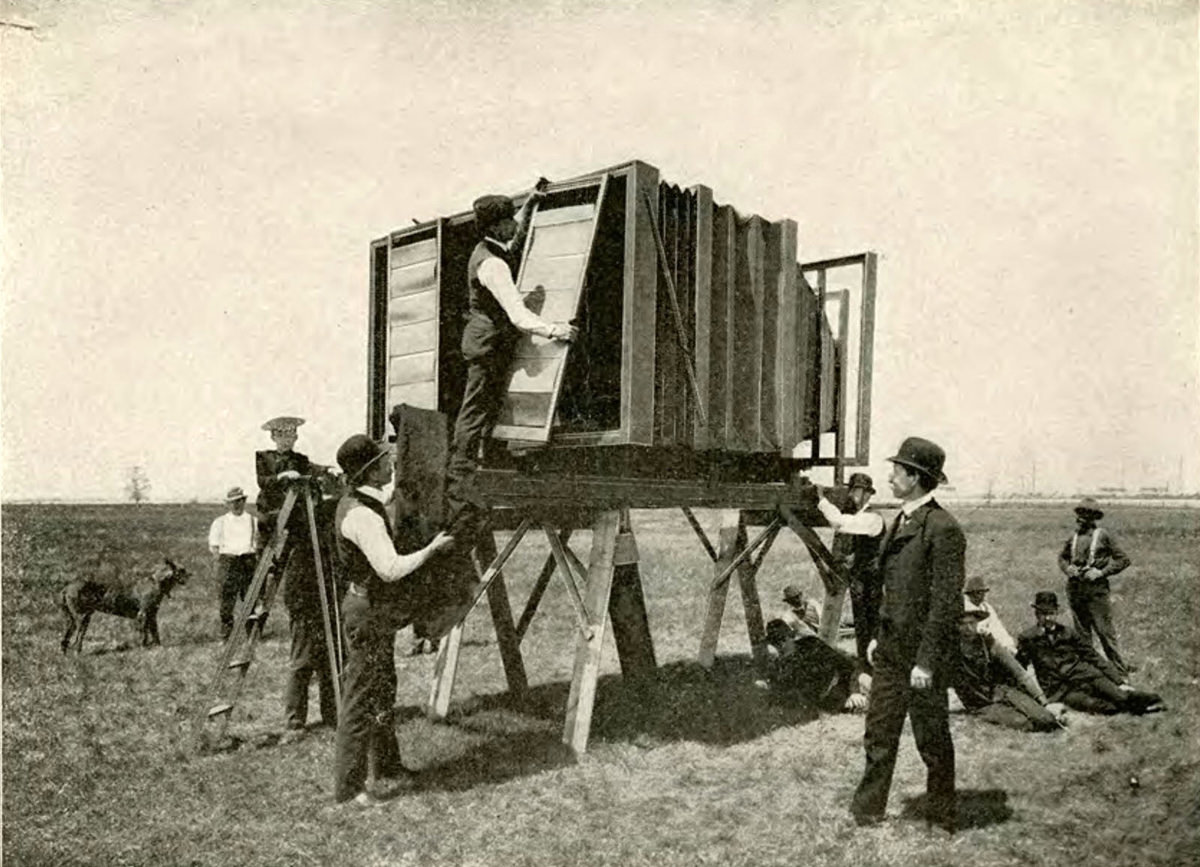
Out on an open field, a towering box camera sits on a timber platform like a small shed raised on stilts, its accordion bellows and broad side panels hinting at the scale of early photographic equipment. Several men cluster around it—one climbing up to adjust the front, another steadying a dark cloth and tripod—while a suited onlooker in a bowler hat watches the proceedings with hands at his sides. The horizon is wide and spare, turning the setup itself into the main event, a striking snapshot of invention meeting practicality.
Getting an exposure in this era was as much engineering as art: leveling the apparatus, aligning the lens, managing light, and preparing plates demanded teamwork and patience. The scene reads like a public demonstration or field experiment, with people seated in the grass as though waiting for the decisive moment when the shutter finally clicks. That sense of anticipation—machinery poised, operators focused—captures the hands-on spirit that powered early camera technology.
For readers drawn to the history of photography, “Setting up the camera” offers a vivid reminder that images once required construction, not just composition. The oversized camera, the improvised scaffolding, and the careful choreography around it speak to a period when inventors and operators were still testing what the medium could do outdoors. It’s a compelling piece for anyone exploring vintage inventions, early photographic processes, and the everyday labor behind the pictures that now feel effortless.