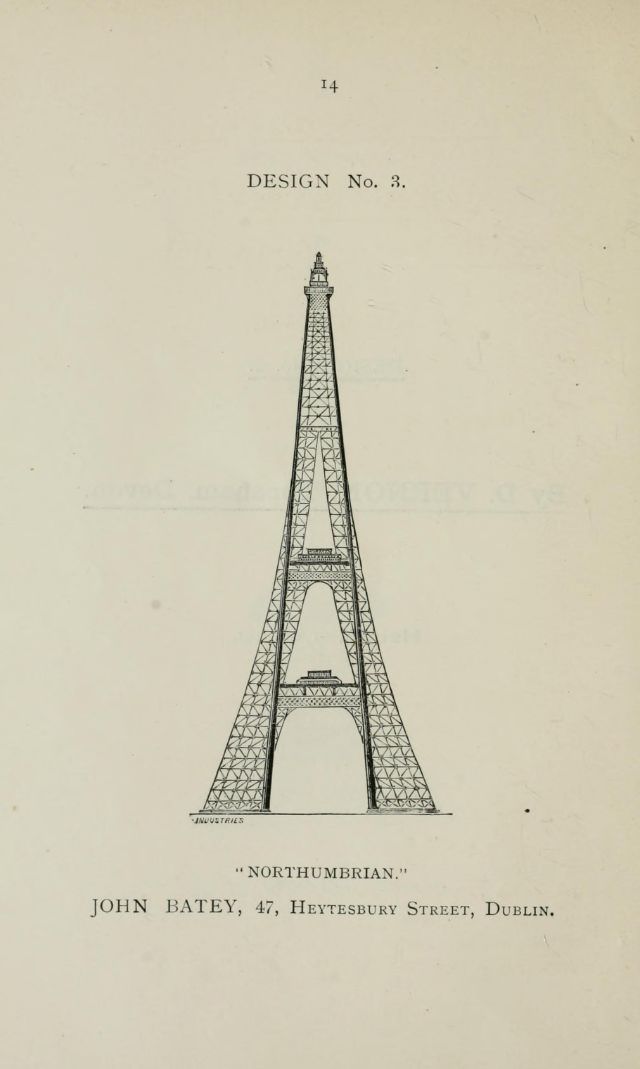
Ambition practically radiates from this competition plate, labeled “Design No. 3,” where a slender iron lattice tower rises in clean, confident lines toward a compact crown. The drawing’s crisp symmetry and open framework evoke the late‑Victorian fascination with engineering as spectacle, the kind of bold proposal that could have redefined London’s skyline. Even on paper, the structure reads as a monument to modernity—light on its feet, yet determined to be seen from miles away.
Look closer and the concept reveals thoughtful staging: broad legs flare outward to a vast central arch, while intermediate platforms suggest viewing levels or functional galleries suspended within the trusswork. The design balances ornament and utility, borrowing the language of industrial bridges and exhibition architecture to create something both airy and monumental. In an era when “inventions” and civic pride went hand in hand, such submissions show how designers imagined metalwork not merely as construction, but as culture.
Printed beneath the tower is the proposal name “Northumbrian,” along with the entrant’s details—John Batey of Heytesbury Street, Dublin—hinting at how widely this Great Tower competition reached beyond England. With more than fifty competitive designs said to have been submitted for London in 1890, this sheet stands as a window into the era’s speculative creativity, where paper towers competed for attention long before any foundations were dug. For readers interested in Victorian architecture, engineering history, and London’s unrealized landmarks, it’s a striking reminder that city skylines are shaped as much by abandoned ideas as by built stone and steel.