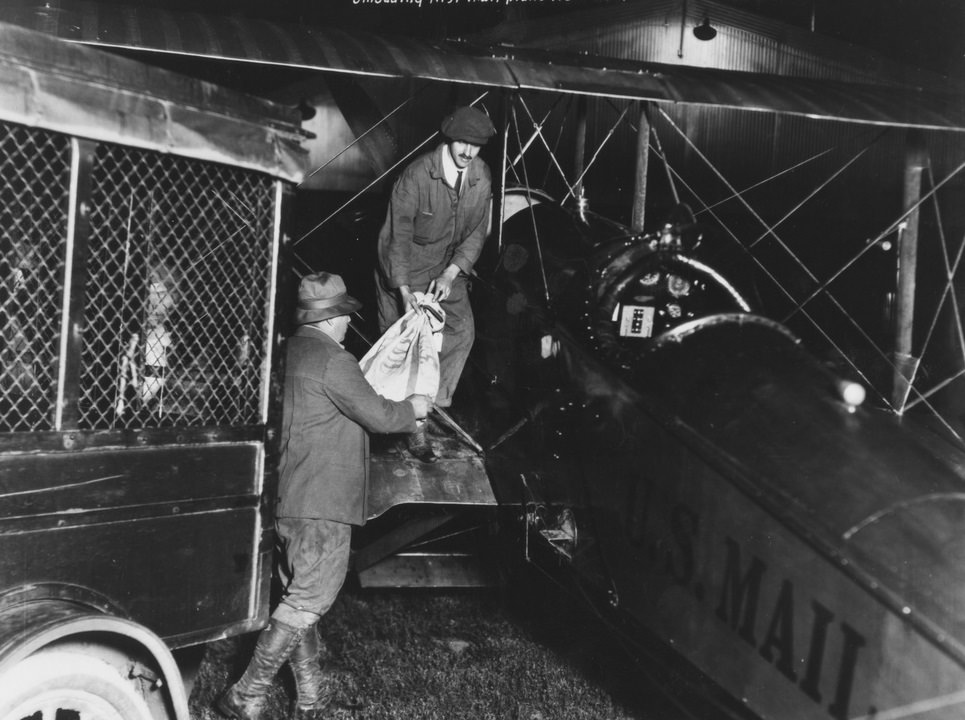
Under the dim shelter of a hangar, a pair of workers make the handoff that kept the nation’s letters moving: heavy mail sacks passed from a waiting vehicle to an airplane marked for airmail service. The scene is practical and unglamorous—boots in the grass, sleeves rolled, faces intent—yet it speaks to a new kind of speed that was reshaping communication in the 1920s. In Omaha, Nebraska, on July 1, 1924, the “invention” on display isn’t a gadget so much as a system: air transport made routine through labor, schedules, and coordination.
Look closely and the era’s aviation hardware reveals itself in cables and struts, a reminder of how early airmail flights relied on lightweight frames and careful ground handling. The mail truck’s caged side panel and the nearby ramp create a tight, efficient workflow, designed for quick transfers before the next departure. Even without seeing the wider airfield, the photograph conveys the urgency of the job—mail moved in bulk, by hand, in spaces where weather, darkness, and mechanical limits could never be ignored.
For readers exploring the history of airmail in Omaha and across the United States, this image offers a grounded counterpoint to heroic pilot lore. It highlights the everyday infrastructure behind faster delivery: the vehicles that met the planes, the crews who lifted and counted, and the sheltered bays where cargo changed hands. As a snapshot of early 20th-century innovation, it captures how aviation slipped into ordinary life—one sack at a time—until “airmail” became a familiar promise rather than a daring experiment.