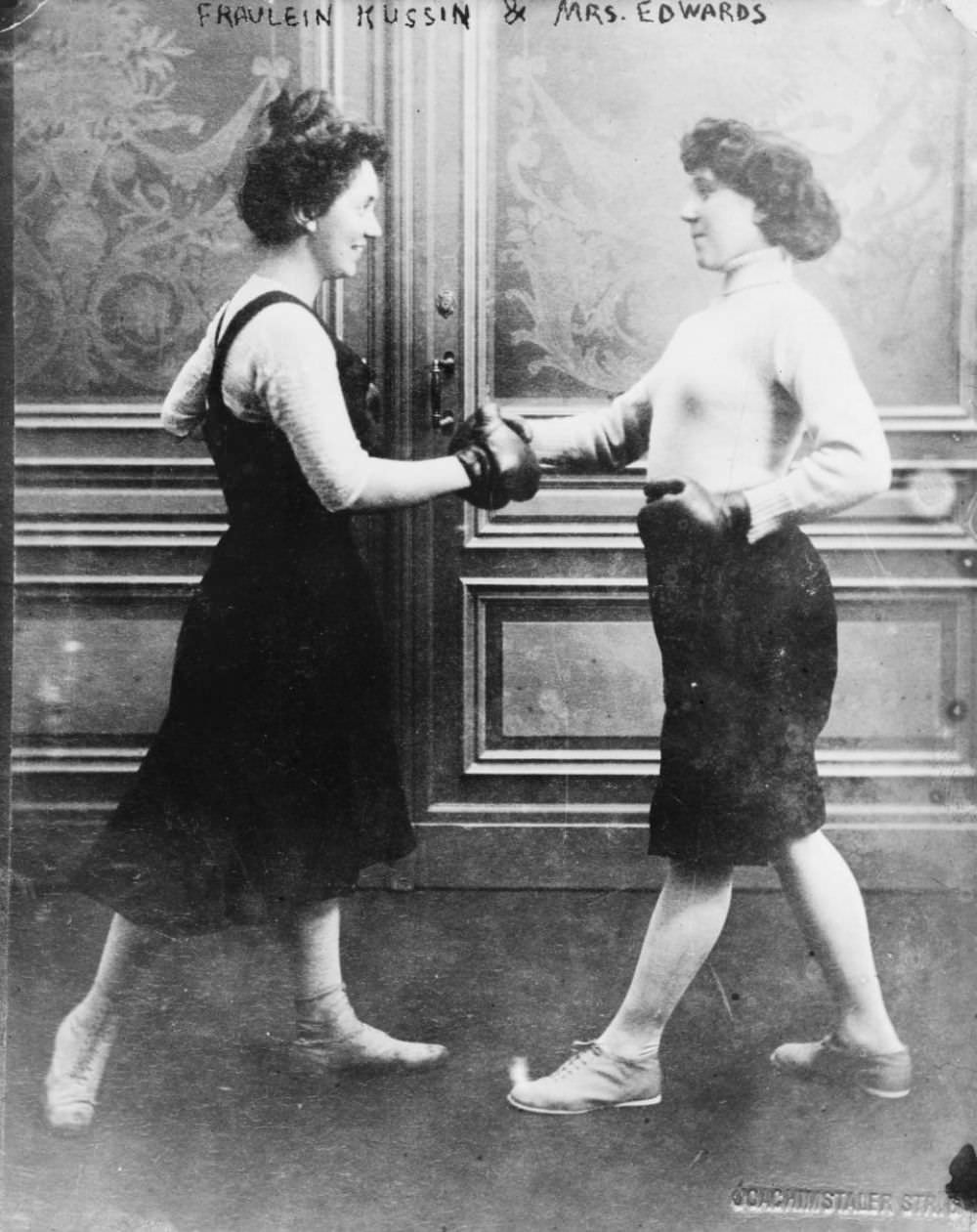
Gloved hands meet at center frame as sisters Booka and Chris Durack square up for practice in Australia, 1916, turning a genteel interior into a makeshift gym. Their stance is relaxed but ready—one in a dark dress layered over a light blouse, the other in a pale top and skirt—proof that early twentieth‑century training could happen without the uniforms we now associate with boxing. Ornate wall panels and the polished floor heighten the contrast between domestic surroundings and combat sport.
What lingers most is the calm confidence in their posture, suggesting skill built through repetition rather than novelty staged for the camera. Female boxing in the Victorian and Edwardian imagination was often treated as spectacle, yet moments like this hint at discipline, athletic curiosity, and the quiet seriousness of sparring. Even without the roar of a crowd, the image carries the rhythm of practice: measure distance, test timing, learn control.
For readers searching women’s boxing history, Australian sport heritage, or rare archival photos of female prizefighters, this photograph offers a striking window into an era when women’s participation was frequently questioned but never absent. The Durack sisters’ speed-bag session (as recorded in the title) speaks to training methods recognizable today—hand speed, coordination, endurance—rendered in period clothing and early photographic grain. It’s a small scene with a large story: determination, family partnership, and the long roots of women in the ring.