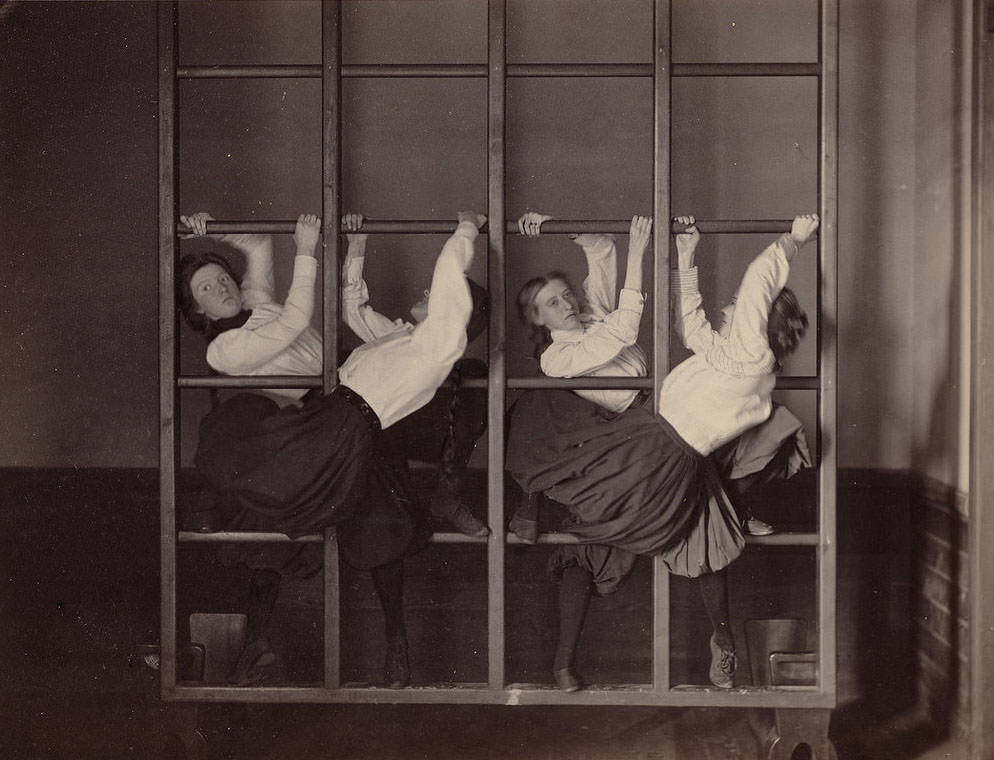
Arms hooked over high wooden bars, a row of students twists and leans into a coordinated exercise that feels halfway between gymnastics and calisthenics. Their long skirts and buttoned blouses move with the strain of the pose, reminding modern viewers that physical education in Boston’s schools had to fit the clothing and expectations of the 1890s. The simple indoor setting—sturdy frames, a polished floor, and spare walls—keeps attention on posture, balance, and the discipline of the drill.
In the late nineteenth century, school sports and “physical culture” were often promoted as tools for health, character, and self-control, especially in growing cities. The rigid geometry of the apparatus echoes that period’s fascination with measured progress: bodies trained through repeatable routines, supervised practice, and orderly space. Details like the students’ concentrated expressions and the uniformity of the movement give these rare historical photos the feel of a classroom lesson—only the subject is strength and coordination.
For anyone searching for Boston school history, 1890s student life, or early physical education, these images offer more than novelty; they show how everyday exercise was staged, taught, and documented. The scene captures a moment when “sports” could mean structured indoor training as much as competitive games, shaped by the era’s ideas about health and propriety. Look closely and you can almost hear the instructor’s count and the quiet creak of the wooden bars as the class holds its form.