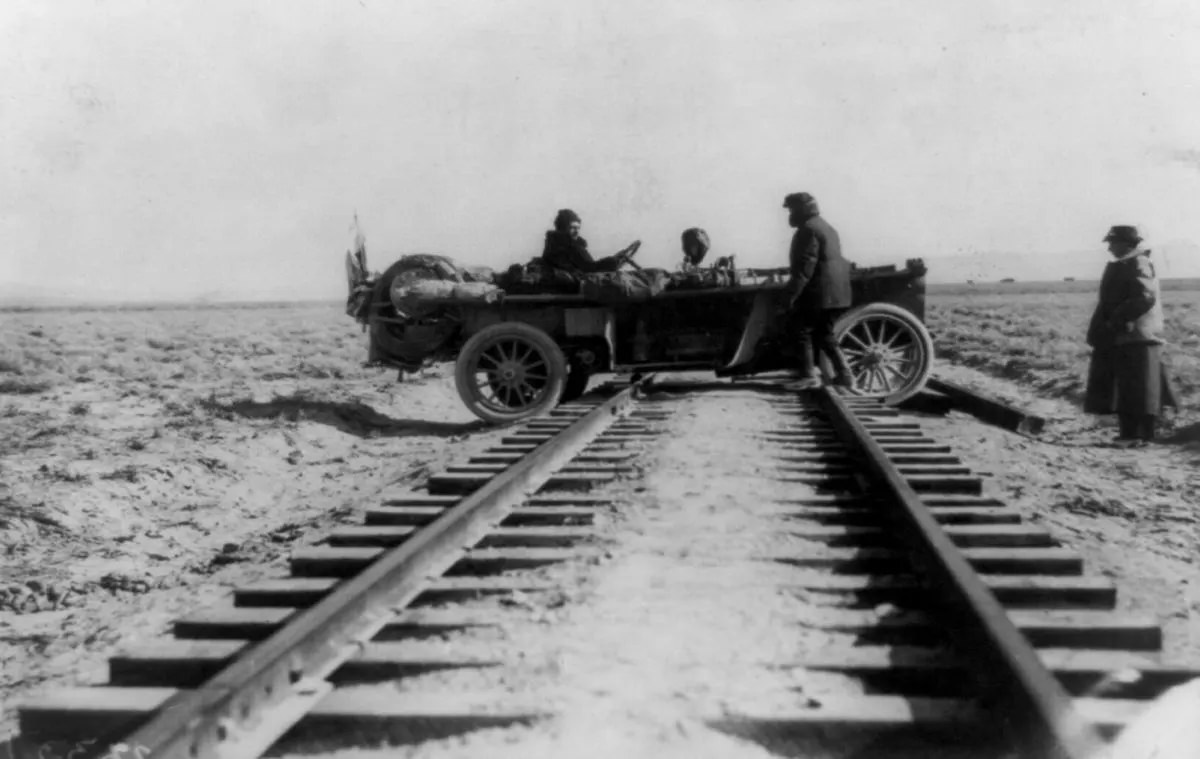
Across an empty stretch of landscape, a hardy early automobile straddles a set of railroad tracks, its spoked wheels and low, open body silhouetted against a pale sky. Bundled figures cluster around the car—one at the wheel, another standing beside it—suggesting the kind of improvised teamwork that long-distance motoring demanded in 1908. The scene feels less like a paved “route” and more like a confrontation with the continent itself, where steel rails, sand, and weather could dictate the day’s progress.
In the Great New York to Paris Auto Race, endurance was measured not only in miles but in problem-solving: navigating rough ground, finding passable crossings, and coaxing heavy machines through places never designed for cars. Here the tracks form a stark corridor into the distance, emphasizing both direction and danger—one wrong move and the vehicle could be stuck, damaged, or delayed. Details like the luggage lashed to the rear and the practical clothing of the crew hint at the race’s realities: constant repairs, scarce comforts, and a schedule at the mercy of terrain.
Stunning historic photos like this one bring the 1908 race down to human scale, reminding modern readers that “motorsport” once looked like exploration. The New York to Paris story lives in these candid moments of pause and assessment, when drivers and mechanics turned obstacles into milestones. For anyone searching vintage racing photography, early automobile history, or the legendary New York to Paris Auto Race of 1908, this image offers an unvarnished glimpse of what it meant to chase a finish line across the world.