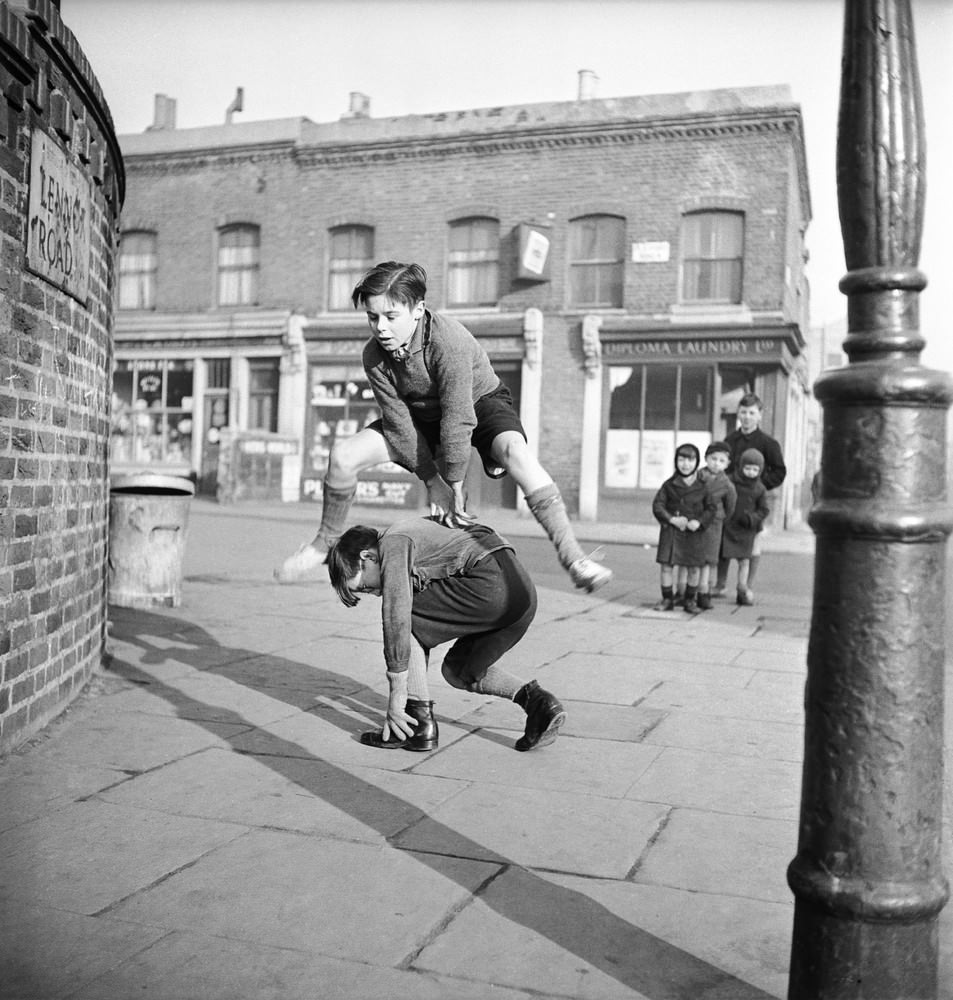
Mid-jump, one boy clears his friend’s bent back with knees tucked and hands braced, turning an ordinary pavement into a playground. The scene is set on a city street lined with brick buildings and shopfront windows, where the hard geometry of curbs and slabs contrasts with the blur of movement and concentration on the children’s faces. It’s a simple moment of leapfrog, yet it carries the unmistakable energy of 1950 childhood—improvised sport, quick daring, and laughter just out of frame.
Along the sidewalk, a small cluster of bundled-up onlookers pauses to watch, their coats and hats suggesting a cool day and a neighborhood routine that includes lingering at street corners. A tall streetlamp and a street sign anchor the composition, while the long shadows stretch across the stones, hinting at low sun and the late-day pull of home. Details like these make the photograph feel lived-in, a candid slice of everyday life rather than a staged sports portrait.
Street games like leapfrog required no equipment, only willing bodies and a bit of trust, which is why they appear so often in mid-century memories and vintage photo archives. For readers searching for 1950s street photography, children’s games, or nostalgic scenes of play, this image offers a vivid reminder of how public space once doubled as a social commons. The joy here isn’t just in the jump—it’s in the community gathered around it, and the way a neighborhood street became a shared stage for youthful sport.