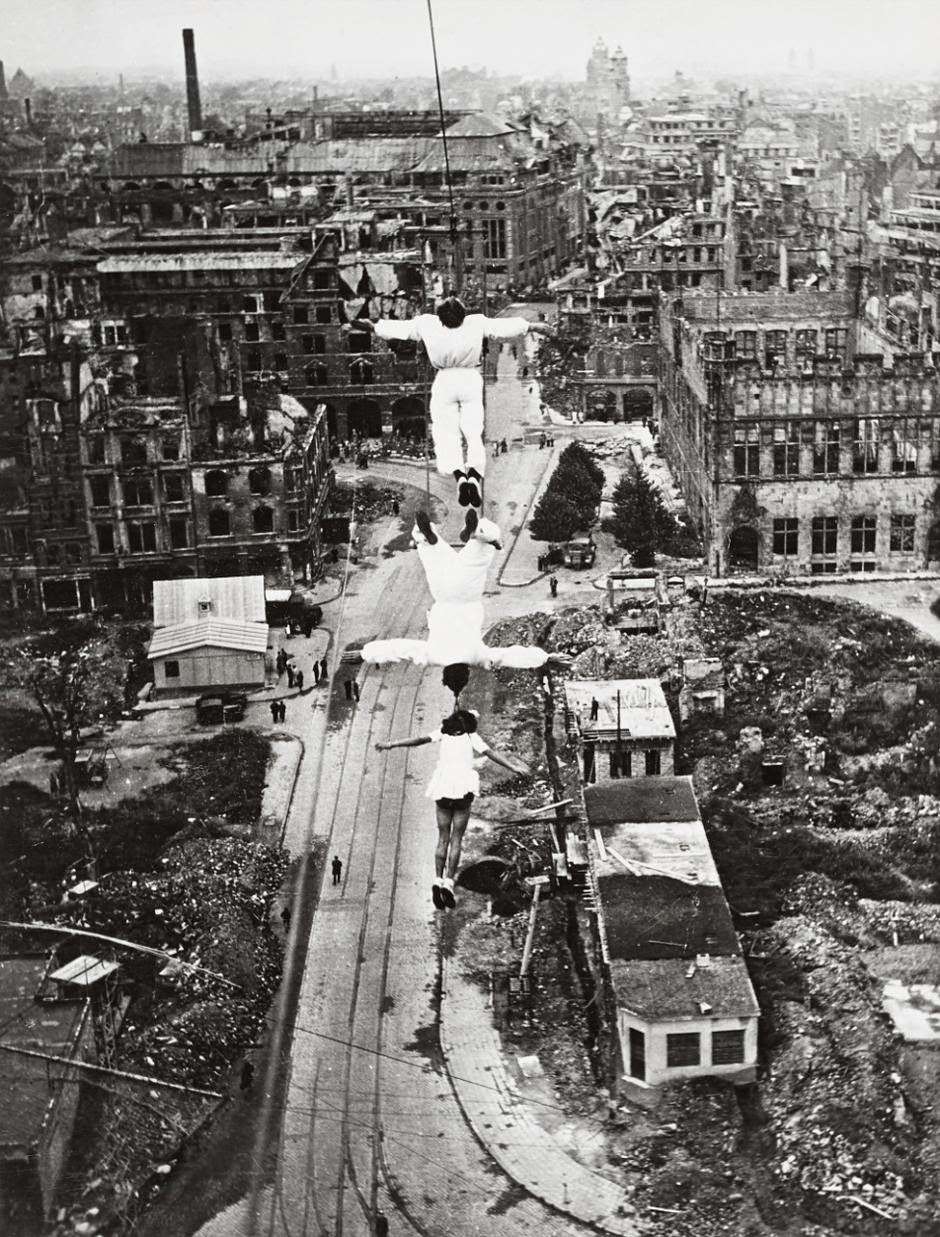
Above the battered rooftops of Cologne’s Heumarkt, three high-wire circus artists form a daring human column, arms outstretched as if to steady the entire skyline. Far below, tram tracks cut through a cityscape of broken walls and exposed interiors, while small figures on the street register the scale of both the ruins and the risk. The performers’ bright costumes and clean lines stand in sharp contrast to the jagged geometry of damage stretching to the horizon.
The composition turns a circus act into a postwar emblem: balance, trust, and precision held against the weight of destruction. Without relying on a big top or a packed arena, the spectacle is staged in open air, making the city itself the backdrop and the audience. Seen through a sports lens, it’s also a portrait of athletic discipline—core strength, coordination, and nerves—captured at the moment where one wobble would change everything.
For readers searching for Heumarkt Cologne 1946, this photograph offers more than a visual record; it hints at how public life and entertainment returned amid reconstruction. The aerial perspective invites a slow scan across streets, temporary structures, and shattered façades, grounding the performers’ height in the realities of everyday movement below. It’s a reminder that in the aftermath of war, feats of endurance could appear not only in stadiums, but suspended above the city itself.