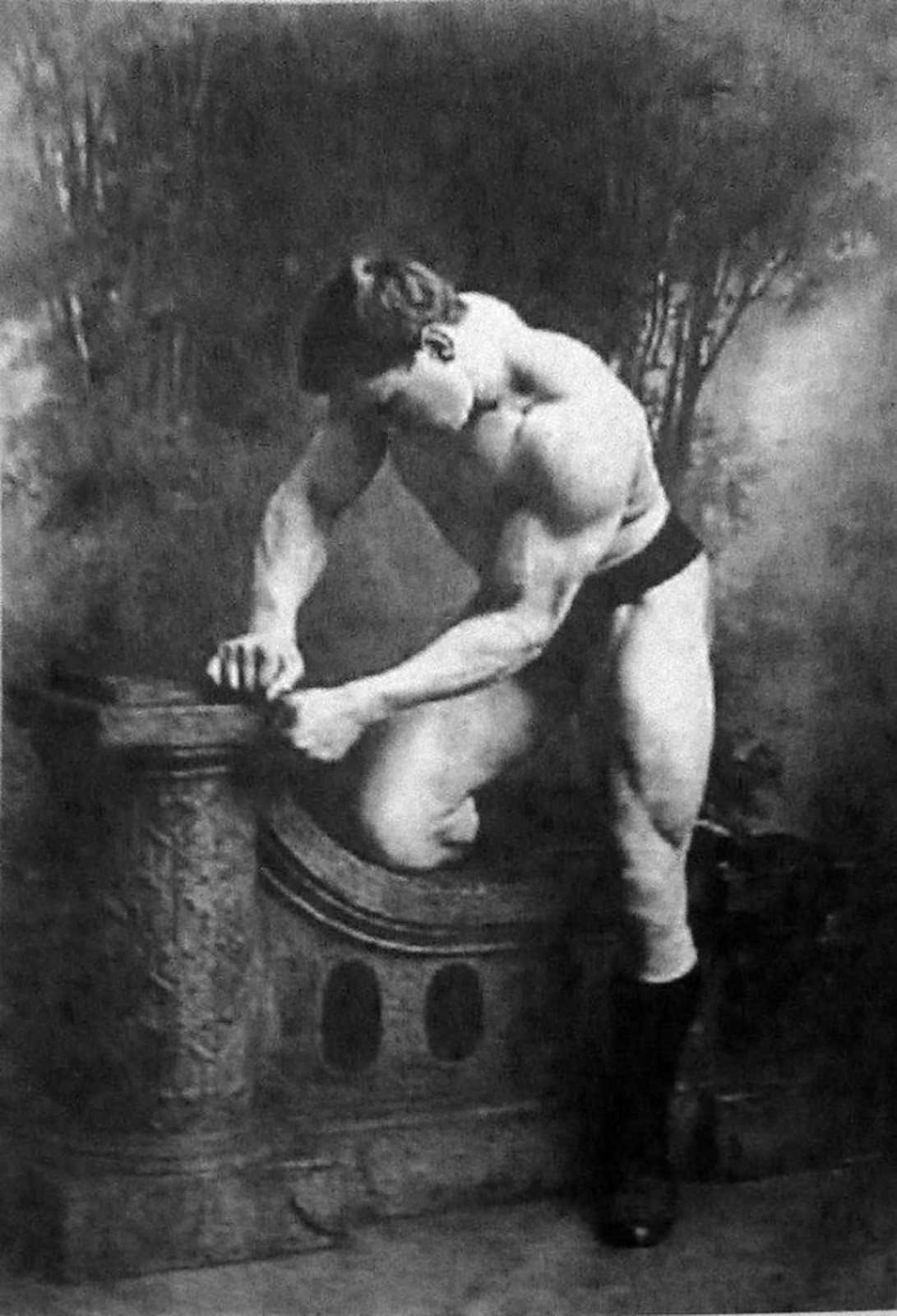
George Hackenschmidt appears here in a carefully staged studio pose from 1900, balancing strength with a sculptor’s sense of display. Leaning forward with his hands braced on a pedestal, he lets the camera read the definition of his shoulders, arms, and torso, while a painted backdrop and classical prop lend the scene an almost gallery-like atmosphere. It’s an early example of athletic photography treating the trained body as both sporting achievement and public spectacle.
Rather than action or competition, the focus is control—muscles held under tension, posture arranged to emphasize symmetry and power. The minimal attire and soft lighting highlight contours that would have been instantly recognizable to audiences fascinated by “strongmen” and the emerging culture of physical fitness. In the era’s visual language, this kind of portrait functioned as proof: disciplined training made strength visible.
For readers interested in the roots of modern bodybuilding and strength sports, this George Hackenschmidt photo offers a vivid bridge between Victorian-era physical culture and the fitness industry that followed. The image speaks to how athletes were marketed, admired, and mythologized at the turn of the century, when a single well-composed photograph could define a reputation. It remains a compelling historical artifact for anyone exploring early 1900s sports history, classic physique ideals, and the origins of bodybuilding imagery.