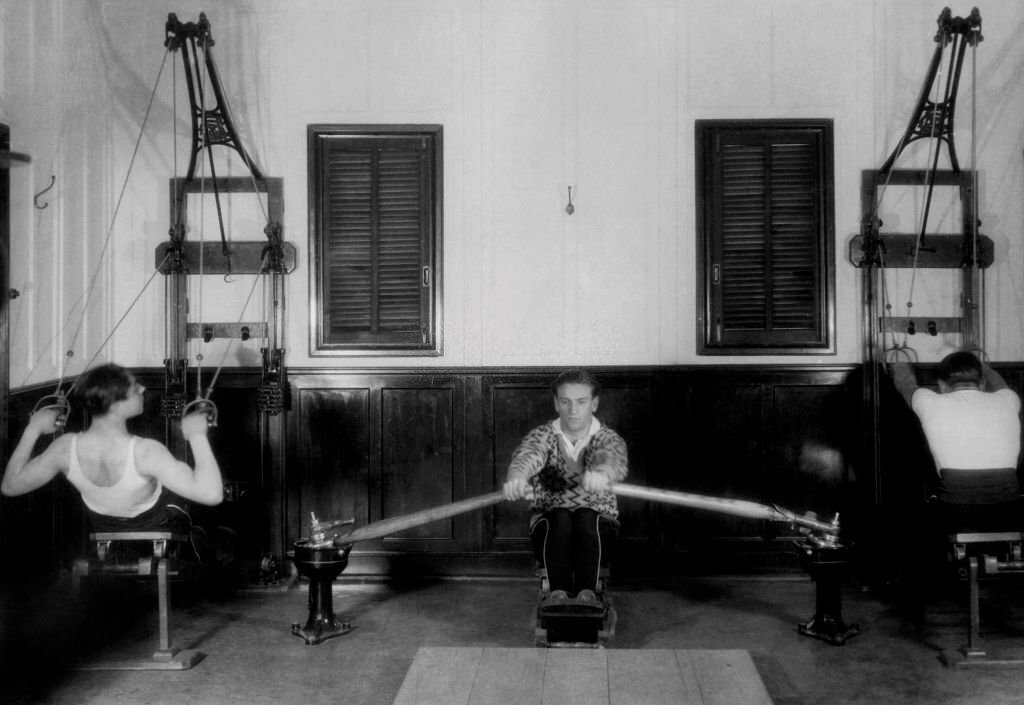
Inside a shipboard gym, three sailors work in unison amid towering pulley rigs and polished metal fittings, turning a compact room into a disciplined training hall. The symmetry of the equipment—cables, weights, and handles—frames the men as they push and pull through controlled repetitions, suggesting a routine built as much on endurance as on strength. Even without the sound of engines or waves, the setting feels unmistakably maritime: practical, enclosed, and designed for efficiency.
The title, “Fitness of the ship Duilio, 1930,” points to a moment when naval readiness included structured physical culture, not just seamanship and drill. One figure strains against a rowing-like apparatus while the others work cable machines that resemble early prototypes of today’s gym stations, reminding us how “modern” fitness often has surprisingly deep roots. These contraptions look strange at first glance, yet their purpose is familiar—build muscle, maintain stamina, and keep bodies prepared for demanding work at sea.
For readers drawn to weird exercise machines and workout methods from the past, this historical photo offers a vivid snapshot of sports and training as it was practiced in an institutional setting. The clean lines of the room and the mechanical elegance of the gear highlight an era fascinated by measurable improvement, where strength could be engineered through steel, pulleys, and repetition. It’s a small scene with a big story: how fitness traveled into everyday spaces—even aboard a ship—and became part of the routine of the 1930s.