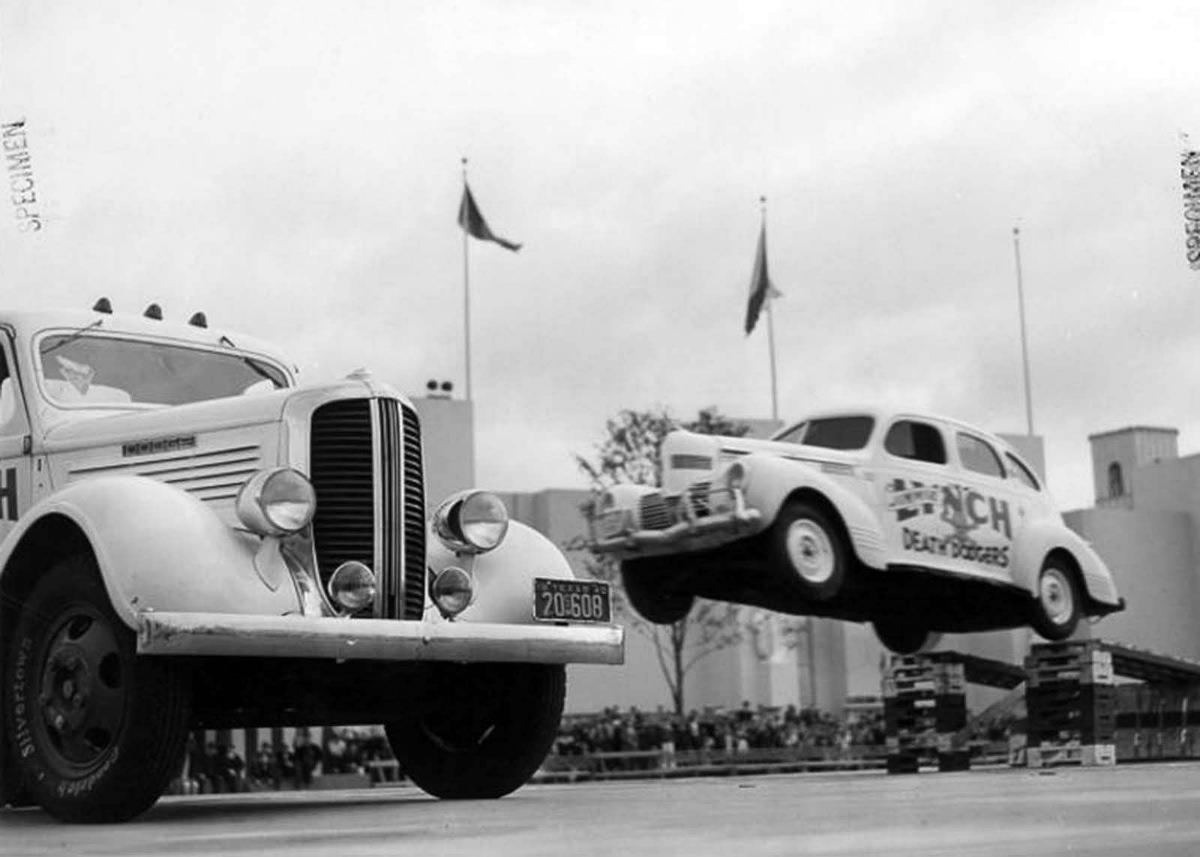
Midair for an instant, a sedan hangs above a makeshift ramp as another car looms in the foreground, its grille and fenders filling the frame like a steel wall. Painted lettering on the airborne vehicle reads “Lynch” and “Death Dodgers,” a rolling billboard for the daredevil troupe led by Jimmie Lynch. The blurred crowd line and flagpoles in the distance hint at a public arena where speed, noise, and spectacle drew families to watch danger performed as entertainment.
In the 1940s, this kind of stunt driving sat at the crossroads of sport and show business—part precision, part bravado, and always marketed as a test of nerves. The geometry of the scene tells the story: stacked platforms, a short launch, and a leap designed to look impossible while remaining just barely controllable. Even without a crash frozen on film, the setup evokes the hard-edged theater of “auto thrill shows,” when dented sheet metal and near misses were the price of admission.
For anyone searching vintage motorsport history, Jimmie Lynch and his Death Dodgers represent an era when car culture meant more than transportation—it meant performance. The photo’s clean composition preserves details that enthusiasts love: period body styles, hand-painted signage, and the improvisational engineering of ramps and supports. It’s a snapshot of 1940s sports entertainment at full throttle, capturing the moment right before gravity—and the crowd’s roar—takes over.