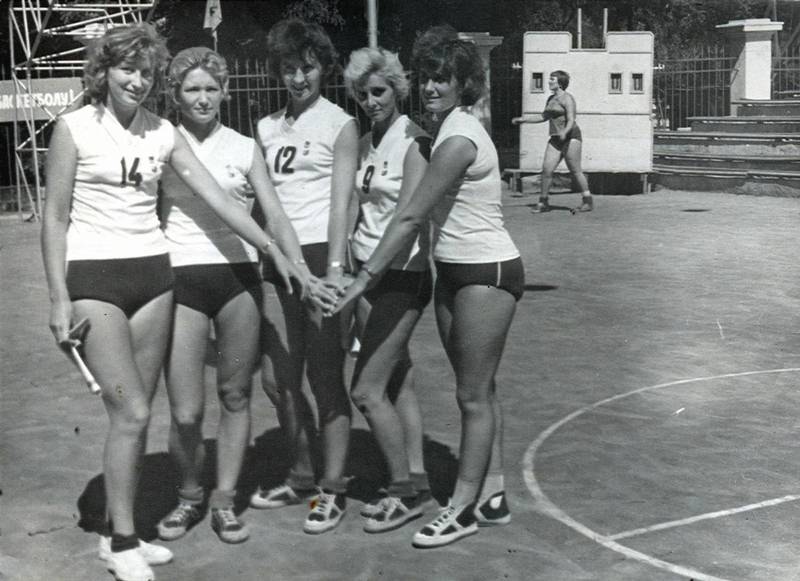
Five young women in numbered sleeveless jerseys and dark athletic shorts pose shoulder to shoulder on an outdoor court, their hands stacked together in a gesture that reads like team spirit just before play. The painted boundary lines curve across the ground at their feet, while benches, fencing, and a small utility structure suggest a public sports ground rather than a private club. Even without a scoreboard in sight, the scene carries the crisp, purposeful energy of organized competition.
In the 1930s Soviet imagination, sport was more than recreation; it was a public language of discipline, modernity, and collective strength. Uniforms, numbers, and synchronized camaraderie turned athletes into symbols, and women’s participation signaled a new kind of visibility—healthy bodies presented as proof of a forward-looking society. The confident stances here, relaxed yet ready, hint at training routines and team drills that extended far beyond the moment of the camera shutter.
Details in the background—an athlete moving across the far side of the court, spare equipment, the geometric lines of the playing surface—help place these “sport girls” in the everyday reality of Soviet physical culture, not just in staged propaganda. For readers searching vintage Soviet sports photos, women athletes of the 1930s, or the history of physical education in the USSR, this image offers a vivid fragment of that world. It invites a closer look at how camaraderie, competition, and state ideals met on the court, one team huddle at a time.