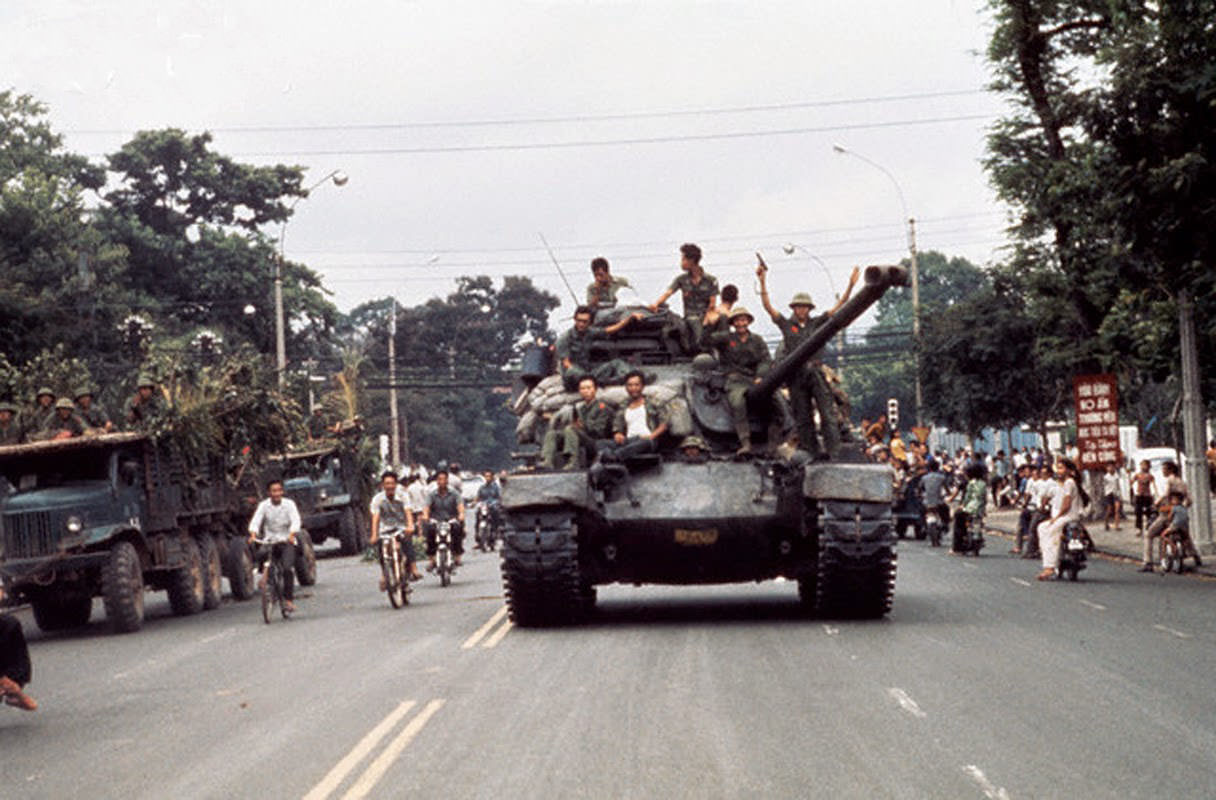
A wide Saigon boulevard becomes a corridor of surrender and spectacle as armored vehicles roll forward, their tracks centered on the road’s faded lines while soldiers ride high on the turret. Trucks follow behind, packed with troops and gear, and the city’s everyday life—bicycles, pedestrians, and roadside onlookers—presses in on both sides, watching history move past at street level. Overhead wires and tall trees frame the scene, emphasizing how ordinary urban infrastructure suddenly served as the stage for the Vietnam War’s final act.
Tension and exhilaration mingle in the gestures: a raised arm, a cluster of men perched on steel, faces turned outward as if taking in an unfamiliar capital now within reach. Civilians appear close enough to touch the convoy, some standing back cautiously, others edging nearer, creating a charged boundary between military momentum and public uncertainty. The photograph’s color and clarity make the moment feel immediate, not distant—less a battlefield than a city absorbing the shock of transition.
For readers searching the end of the Vietnam War, the fall of Saigon, or North Vietnamese troops entering Saigon on tanks and trucks, this image offers a vivid anchor to an event often summarized in a single sentence. It conveys not only conquest but the abrupt reordering of a metropolis, where engines, uniforms, and crowds collide in a compressed, unforgettable frame. Seen today, it invites reflection on what “ending” a war looked like in real time: not quiet closure, but a loud procession down a public street.