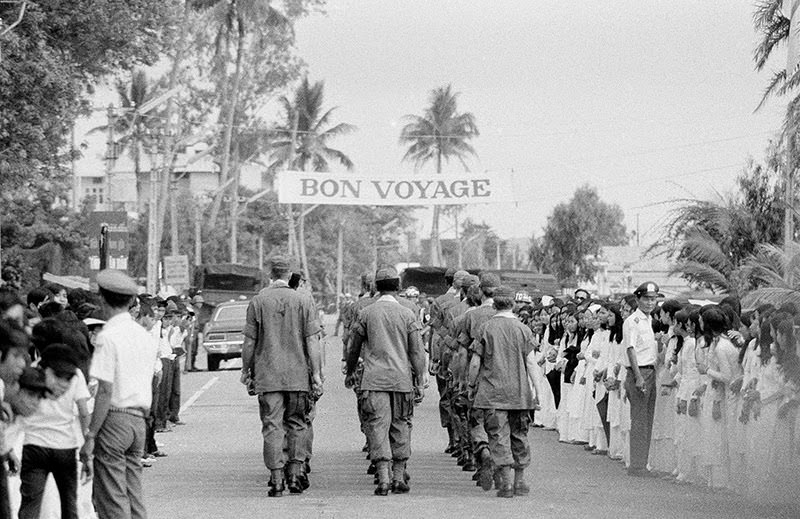
Under a roadside banner reading “BON VOYAGE,” a column of uniformed men walks away from the camera, framed by palm trees and a corridor of onlookers. The crowd lines both sides of the road, creating the uneasy feeling of a send-off that is equal parts ceremony and farewell. Even without knowing the exact place or moment, the scene hints at how the Vietnam War touched public spaces—turning ordinary streets into stages for departure, uncertainty, and quiet dread.
What makes this kind of Vietnam War photo so affecting is its restraint: no gunfire, no explosions, just movement and distance. The soldiers’ backs recede toward waiting vehicles while civilians—some in light-colored clothing—stand close, watching, waving, or simply witnessing. The banner’s cheerful words clash with the heavier reality suggested by military uniforms and guarded posture, capturing the psychological dissonance that defined so much of the conflict between capitalism and communism.
As part of a larger gallery of striking Vietnam War images, this frame reminds us that horror is not always loud; sometimes it lives in the pause before the unknown. It speaks to the wartime machinery of departures and rotations, to communities temporarily united along a road, and to the human cost implied by every step forward. Readers searching for Vietnam War history photos will recognize in this moment the war’s grim intimacy—how it moved through daily life and left lasting echoes on both sides of the divide.