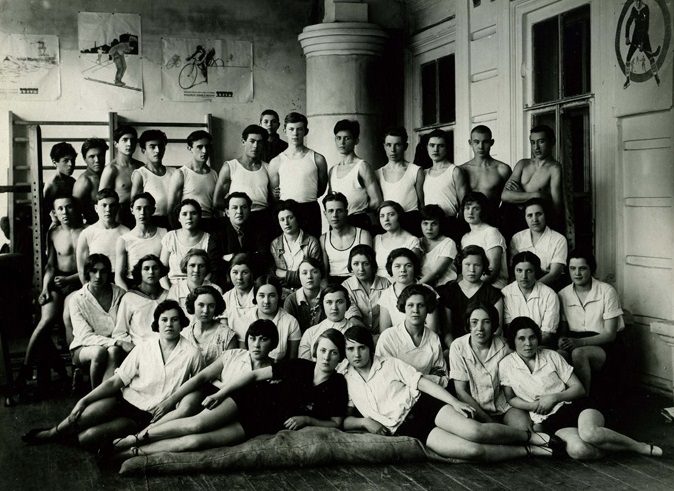
Rows of young athletes and their instructors fill the room, posed with an almost ceremonial precision that feels unmistakably 1930s. The women in light gym tunics sit and recline at the front, while a line of men in sleeveless training shirts stands behind them, creating a layered portrait of a sports collective rather than a set of individuals. Faces are steady, direct, and unsmiling—more like a team roll call than a casual studio session—hinting at the seriousness attached to physical culture in the Soviet era.
Along the back wall, simple posters of skiers, runners, and cyclists quietly reinforce the message: sport as everyday discipline, sport as modernity, sport as duty. The setting looks like an indoor training hall, complete with tall windows and worn floorboards, the kind of practical space where drills, calisthenics, and group instruction could happen year-round. Clothing and posture emphasize function over fashion, yet the careful arrangement and confident stares give the scene a striking visual rhythm.
Strong Bodies, Strong Will brings these vintage Soviet sport girls into focus as symbols of a broader 1930s ideal—health, endurance, and collective strength presented as social progress. For readers drawn to Soviet history, women’s athletics, and vintage sports photography, the image offers details worth lingering over: uniformity and individuality side by side, the blend of youth and authority, and the quiet propaganda of everyday training. It’s a reminder that behind the era’s slogans were real gym floors, real teams, and real young women learning to carry themselves like the future depended on it.