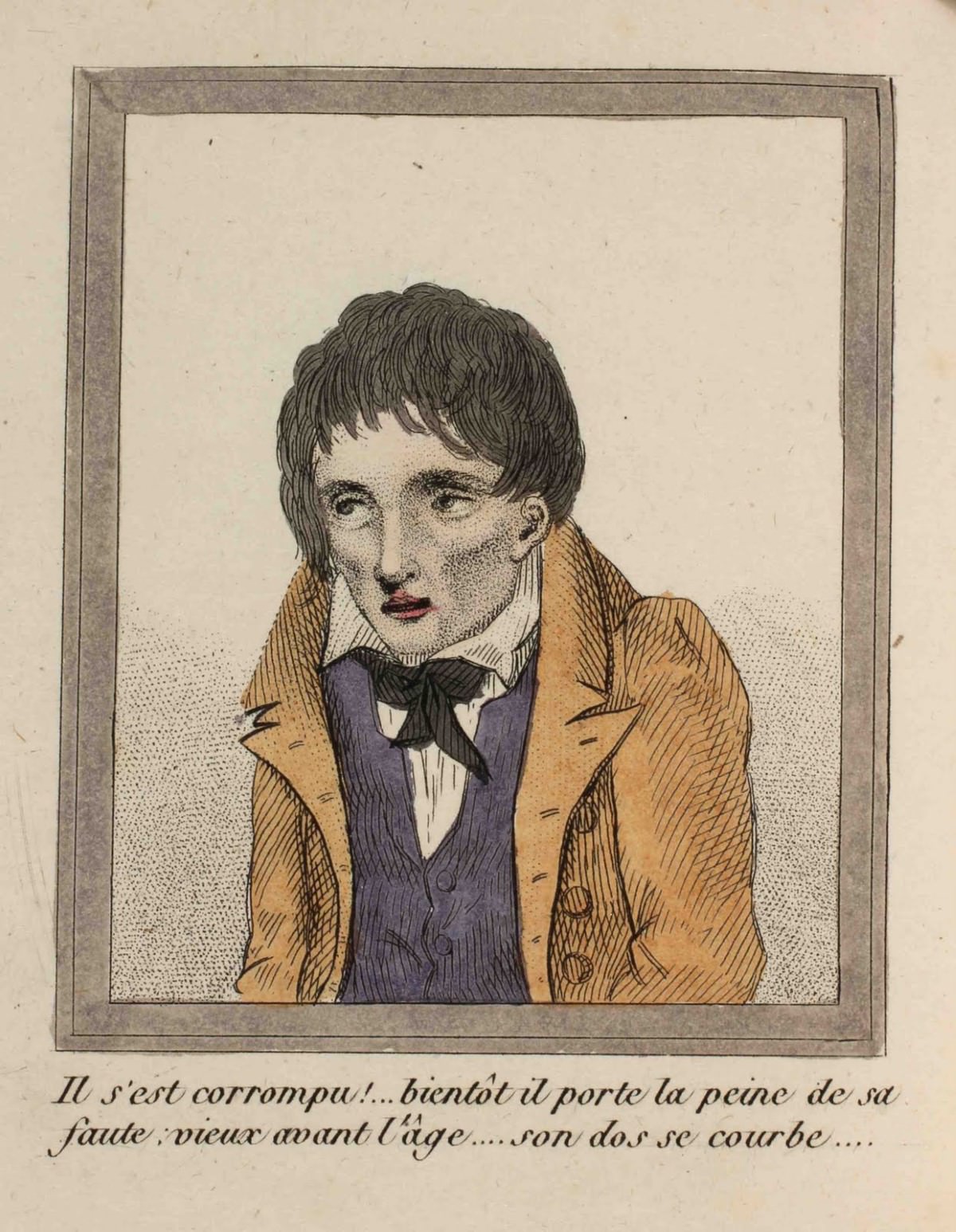
A young man in a threadbare elegance leans forward as if the weight of his own choices has pulled his shoulders down. His coat hangs heavy, his dark cravat sits stiff at the throat, and the wary sideward glance suggests a mind that no longer rests easily. Even without a named setting, the portrait’s careful linework and muted hand-coloring place it firmly in the tradition of nineteenth-century moral illustration, where a single figure can stand in for a whole cautionary tale.
Beneath the framed vignette, the French caption spells out the judgment: corruption comes quickly, punishment follows, and a person can grow “old before age,” the back bending under guilt. The artist reinforces those words with posture rather than props—no courtroom, no chains, only the subtle collapse of confidence and the pallor of a face that seems already exhausted. It’s a compact lesson in visual storytelling, using clothing and carriage to hint at a fall from youthful promise.
For readers interested in antique prints, early social commentary, and the history of character studies, this artwork offers an evocative example of how morality was staged on paper. The restrained background keeps attention fixed on the human cost of wrongdoing, making the image feel intimate despite its didactic purpose. As a historical piece for a WordPress post, it invites reflection on how earlier audiences were taught to read virtue and vice—not in dramatic spectacle, but in the slow, visible aging of a hunched back.