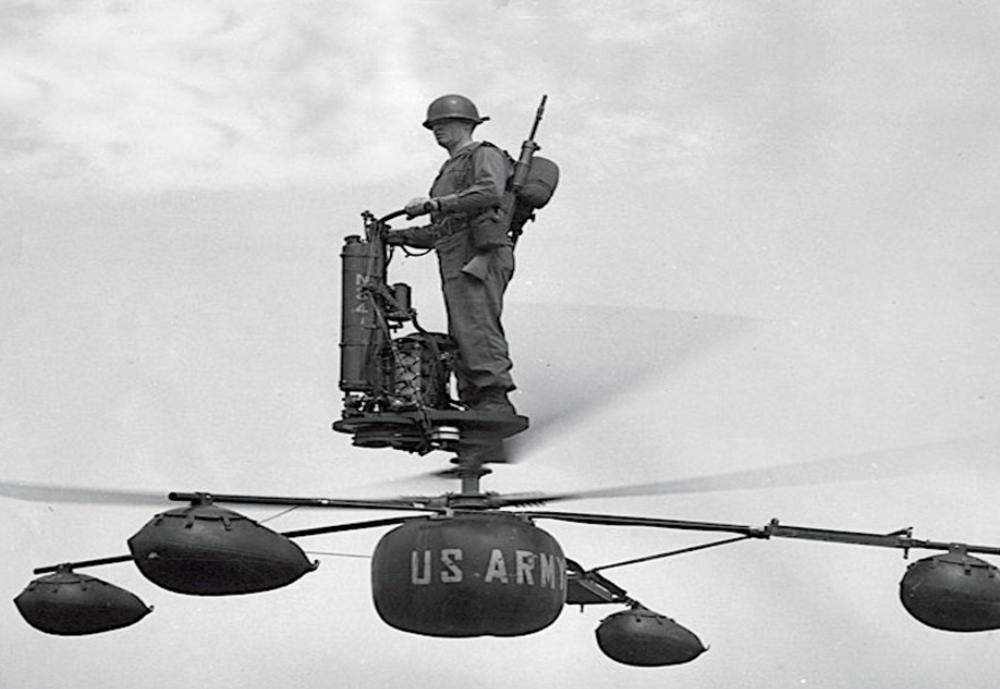
Balanced high above the rotor hub, a helmeted soldier stands on a tiny platform that looks more like a powered pedestal than an aircraft. The words “US ARMY” painted on a bulbous central tank underline the military ambition behind the de Lackner HZ-1 Aerocycle—a one-man personal helicopter concept meant to lift an individual with minimal structure between pilot and spinning blades. Even in stillness, the design reads as daring: exposed mechanics, a tall control column, and a pilot positioned where most helicopters would have a protective fuselage.
The Aerocycle belonged to a mid-century wave of Cold War-era inventions that chased mobility through radical simplicity. Four outrigger floats (or stabilizing pods) extend from the center like a skeletal cross, suggesting attempts to tame balance and ground handling for a machine that had almost no body at all. With the pilot standing upright, weight shifts and vibration would have mattered immensely, making every movement part of the flight-control equation in a way fixed-seat aircraft rarely demanded.
Failure during flight testing is part of what makes this photograph so compelling as aviation history and technology lore. It captures the fine line between visionary engineering and impractical risk, showing why personal helicopter ideas have repeatedly struggled against stability, safety, and training realities. For readers searching for 1950s experimental aircraft, US Army aviation projects, or the story of the de Lackner HZ-1 Aerocycle, this image is a stark reminder that progress often comes from prototypes that proved the point by not working.