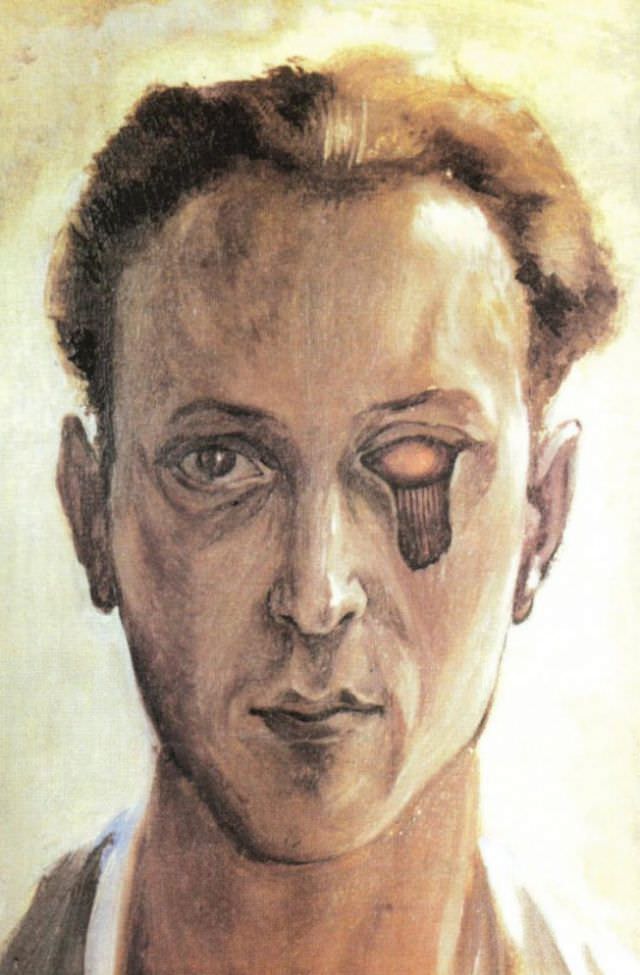
A steady, frontal gaze anchors this self-portrait from 1931, rendered with a restrained palette and a softly lit background that keeps all attention on the face. The sitter’s short, dark hair is brushed back, and the modeling of the cheeks and jaw uses gentle transitions rather than sharp outlines, giving the work a quiet, intimate presence. Even without a named setting, the close cropping and direct composition make it feel like a private encounter between artist and viewer.
The most arresting detail lies around one eye, where a dark, mask-like form interrupts the naturalism and introduces a charged note of symbolism. It could be read as injury, disguise, or psychological emphasis—an intentional distortion that turns the portrait from simple likeness into a statement. That contrast between careful realism and a single disruptive mark invites lingering attention and repeated interpretation.
As an artwork labeled “Self-portrait, 1931,” this piece sits in the long tradition of artists using their own faces to test technique and reveal inner life. The plain backdrop, the concentrated expression, and the deliberate asymmetry all support a narrative of introspection, suggesting a moment when identity feels both known and unsettled. For readers searching for historical art, early twentieth-century portraiture, or self-portrait symbolism, this image offers a compelling entry point into the era’s visual language.