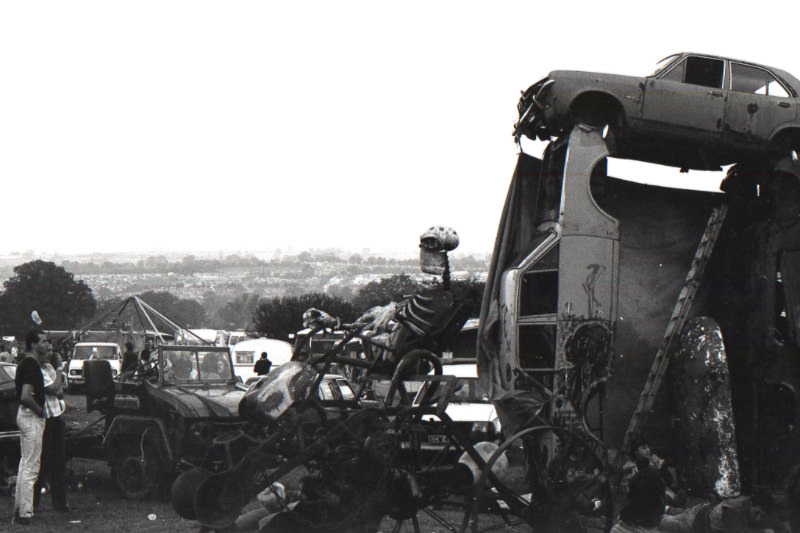
Rust and ingenuity collide in a stark outdoor scene where scrapped car bodies have been stacked into a towering, almost architectural sculpture. A vehicle shell rises like a monolith, capped with another car perched above it, turning the familiar shape of everyday transport into something unsettling and theatrical. In the foreground, twisted frames and exposed metal form a chaotic base, the kind of improvised industrial landscape that defines the Mutoid Waste Company’s reputation for bizarre 1980s artworks.
A skeletal figure appears embedded among the machinery, its bony grin and rigid posture adding dark humor to the heap of reclaimed parts. Around the installation, people linger at a cautious distance, suggesting this was meant to be encountered live—part spectacle, part warning, part celebration of salvage. The open field setting, dotted with other vehicles and temporary structures, reads like a festival or gathering where art, subculture, and DIY engineering meet.
Against a hazy horizon, the photo frames these car-wreck sculptures as more than scrap: they become a commentary on consumption, waste, and the afterlife of industrial materials. The Mutoid Waste Company’s aesthetic thrives on reinvention—taking what’s been discarded and recombining it into confrontational assemblage art that still feels raw decades later. For readers searching for 1980s outsider art, post-apocalyptic sculpture, or automotive scrap installations, this image offers an arresting doorway into that world.