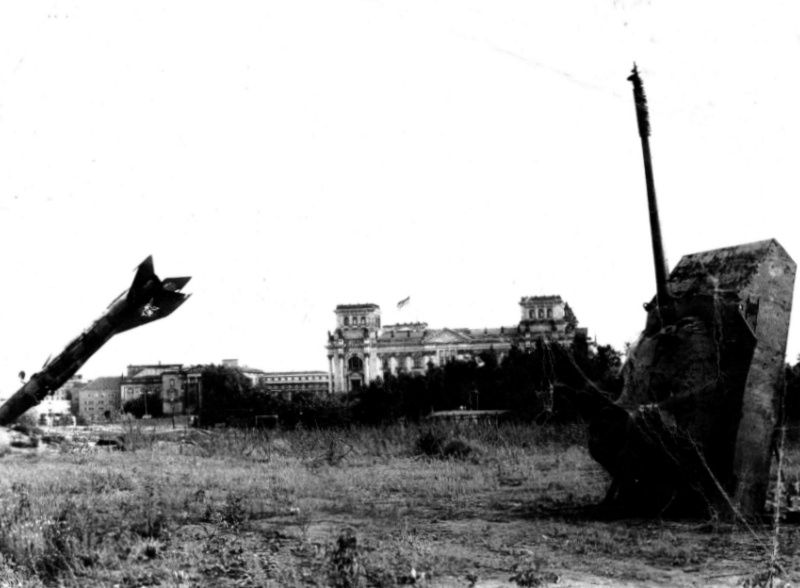
Steel intrudes into the landscape at odd angles, like a set of unfinished gestures left behind after some mechanical storm. In the foreground, heavy, riveted metal forms—suggestive of vehicle parts and industrial offcuts—sit half-sunk in rough ground, while a distant monumental building anchors the horizon. The stark contrast and wide, open space give the scene an unsettling calm, the kind that suits the Mutoid Waste Company’s reputation for turning scrap into spectacle.
Scrapped cars become raw material rather than refuse in this kind of 1980s art, where welding scars and twisted panels are allowed to remain visible as proof of transformation. A long, spear-like element rises from a bulky mass on the right, and another jagged piece angles in from the left, framing the city backdrop with a sense of confrontation. It reads as post-industrial sculpture that doesn’t just decorate a site—it occupies it, challenging the viewer to see automotive debris as a new, aggressive form of public art.
Between the urban architecture in the distance and the rough, improvised “waste” forms up close, the photograph hints at a broader story about late-20th-century creativity, recycling, and punk-adjacent aesthetics. Fans searching for Mutoid Waste Company artworks, scrap metal sculpture, or bizarre car art from the 1980s will recognize the signature tension: playful invention mixed with a scrapyard’s brutality. The result is an image that feels both documentary and mythic, capturing an era when artists tried to outshout consumer culture using its own discarded parts.