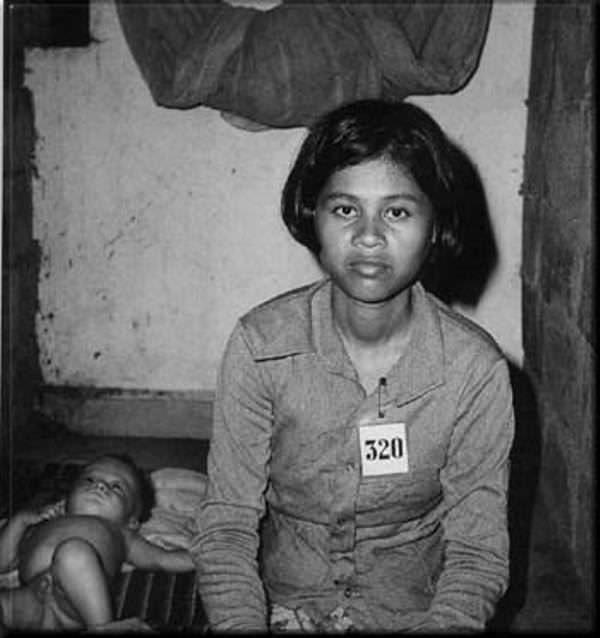
A young girl sits in a stark prison interior, her posture steady as she faces the camera with a tired, guarded calm. A numbered tag is pinned to her chest, an impersonal marker that contrasts sharply with her youth and the soft, domestic reality beside her. Behind her, the rough wall and hanging cloth suggest a cramped cell where privacy is scarce and time is measured differently.
To her left, a baby lies on a thin sleeping surface, small limbs relaxed in uneasy comfort. The pairing of mother and child within confinement turns the scene into more than a record of incarceration; it becomes a meditation on vulnerability during civil wars, when families can be swept into systems designed for control rather than care. Even without visible bars, the tight framing and bare surroundings communicate restriction and uncertainty.
Questions linger in the quiet details—how long they have been there, what circumstances led them into custody, and what the next day might bring. As a historical photo, it offers powerful evidence for readers searching for prison life, women and children in detention, and the human cost of conflict beyond the battlefield. The image asks us to look past statistics and policies, toward the lived experience of survival in the shadow of war.