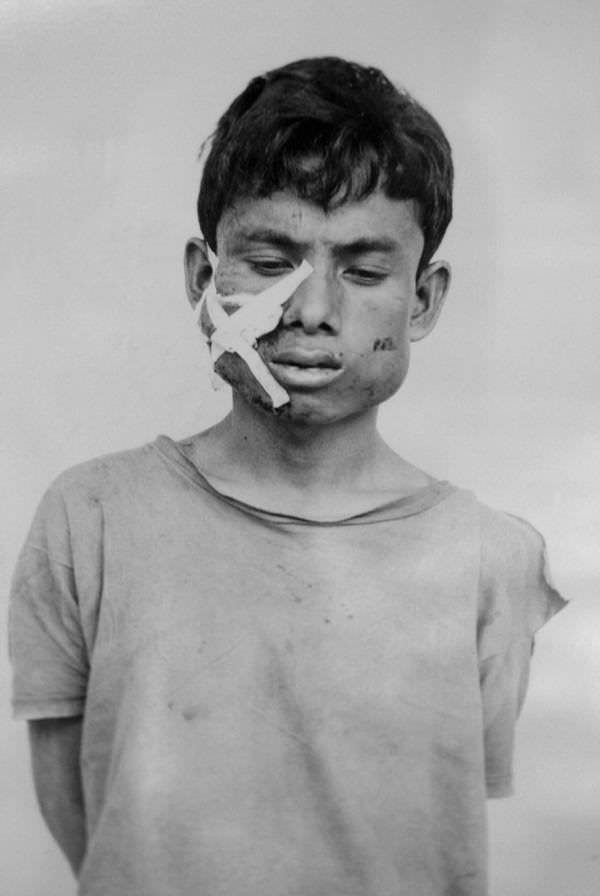
A young detainee stands against a blank backdrop, eyes lowered and shoulders slumped, his face marked by swelling, bruises, and a rough bandage taped across one cheek. The plain shirt and restrained posture suggest confinement rather than daily life, turning the frame into a stark record of vulnerability. In keeping with the post title, the injuries read as the aftermath of brutal treatment rather than an ordinary accident, and the simplicity of the setting makes the human cost impossible to ignore.
Civil wars often reduce people to categories—prisoner, enemy, suspect—yet photographs like this drag attention back to the individual body that bears the violence. The camera’s close, clinical distance echoes documentation used in detention systems and wartime reporting, where proof and propaganda sometimes blur together. With no clear identifiers visible, the image becomes representative of countless young prisoners caught in internal conflicts, subjected to coercion, and left to carry the physical and psychological consequences.
For readers searching civil war history, prisoner abuse, wartime detention, and human rights violations, this photograph serves as a grim entry point into how conflict operates beyond battlefields. It invites careful viewing: the taped wound, the uneven bruising, the resigned expression, and the way the subject is made to stand and be seen. If you share or discuss this material, the most respectful approach is to center the victim’s dignity and to remember that behind every “prisoner” label was a life interrupted by war.