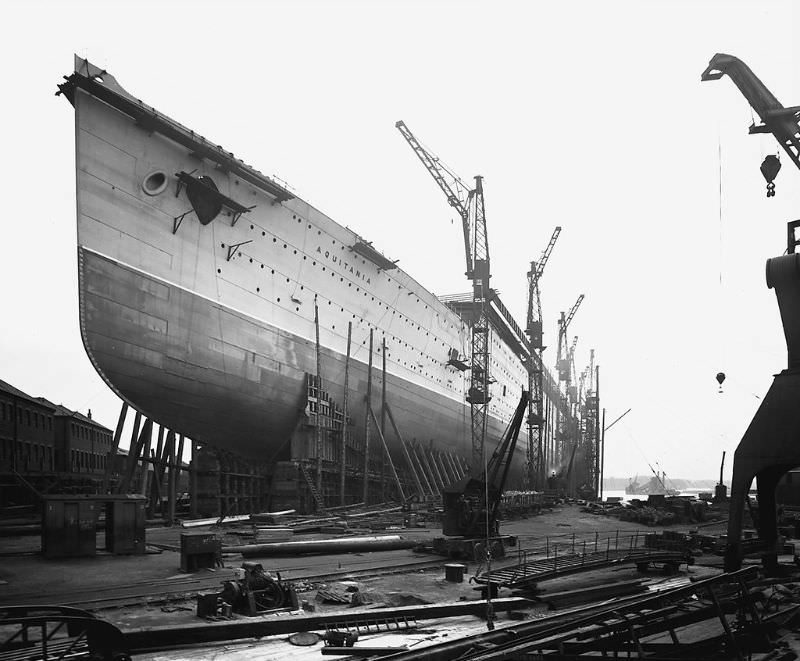
Rising above the slipway at Clydebank, the passenger liner Aquitania dominates the scene, her port side stretching into the distance like a steel cliff. The hull plating is already in place, punctuated by rows of openings and fittings, while the name “AQUITANIA” is visible high on the side, asserting identity long before the ship ever touched open water. Around her, cranes, derricks, and scaffolding create a forest of industrial geometry that frames the immense scale of early 20th-century shipbuilding.
John Brown & Co. Ltd.’s yard appears as much a workshop of inventions as a place of assembly, where heavy lifting gear and precision metalwork meet along the river. The foreground is scattered with rails, beams, and work platforms, hinting at the organized chaos required to turn raw materials into an ocean-going liner. Seen in general view along the port side, the photo emphasizes not only size, but process—an in-between moment when the vessel is neither blueprint nor finished ship, but a monument in the making.
In 1913, images like this carried the promise of modern travel, engineering confidence, and the competitive drive that shaped the era’s great passenger liners. For readers searching for Aquitania under construction, Clydebank shipyard history, or John Brown & Co shipbuilding photographs, this view offers a compelling record of industrial craftsmanship at its peak. It invites a closer look at the texture of riveted plates, the rhythm of the yard’s machinery, and the human ambition embedded in every steel seam.